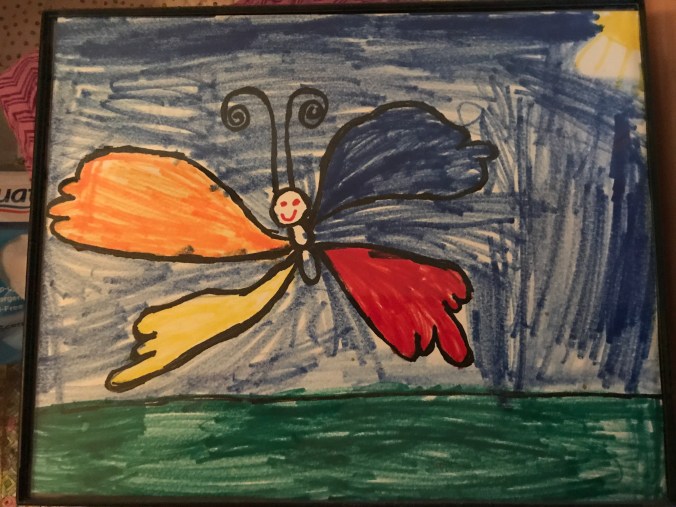
Meant to Bee

Not many know this about us: my wife and I lost a child to complications. Our baby boy would’ve been close to five-years-old by now.

Finding out we were pregnant with our second child was a celebratory call for us, just as it had been when we found out Xaria was on her way to us. A few years after her birth, Guen started talk about having another, especially because we wanted Xaria to have a sibling. We decided to go for it, despite knowing that we were going to experience a gamut of nerves and fears associated with pregnancy. Xaria’s birth was no exception, either, but we did all we could to be best prepared for our new child’s arrival. We would DI the same if and when we had to.

It happened. Guen was in her forties when she was got pregnant for the second time around, and we were well aware of the potential complications associated with older age and pregnancy. We saw all the right doctors and took all the necessary tests, driving back and forth to San Francisco and Stanford. We were full throttle, all positive, and yet cautious with everything Guen did. But still, at our soul’s core, were over the moon.

We talked about names and gifts and sleeping arrangements and how happy Xaria would be and what age she would be when her baby brother or baby sister was five or six-years-old and how our lives would be made much more meaningful with more children. Xaria was getting a younger sibling, too, and she was super excited about it. We, too, were super stoked for her.

There was still a lot of work to do, and we were determined to be thorough with our preparations and medical options. We took advantage of all the advice and tests that were recommended, leaving little room for future regret. Guen and I fielded a slew of Genetic Screening questions from a specialist in San Francisco. We were asked questions about our families, on both sides, about moms and dads, grandmas and grandpas, and great grandparents. We volunteered information regarding any family health issues of which we knew. The conclusion from the screener was that everything was normal. In fact, every test Guen took had come back absolutely positive, making us even more excited to see our baby.

Because of Guen’s age, she was provided information for one more optional test. It was called a Chorionic Villus Sampling (CVS) test, a prenatal exam used to detect abnormalities, birth defects, genetic diseases, and other pregnancy problems. The test was recommended by Doctor Alexander, the same doctor that who delivered Xaria. We loved Dr. Alexander, and we trusted his opinions and judgement.  Guen wholeheartedly agreed to the test

The CVS test involves removing a sample piece of the placenta. It’s done by inserting a long needle through the belly, reaching all the way to the placenta. The sample is then sent to a lab, and the results come back a few days later. Guen was a trooper during the test, a symbol of her determination to ensure a normal, healthy birth.

The CVS results had come in, and so we drove to San Francisco to hear the findings. If I remember correctly, we were apprehensive and emotionally fragile. Up to this point, we had relied on images from ultrasounds and blood samples to tell us that our pregnancy was going well. We studied our baby’s curled form, mysterious and magical on the ultrasound screen, and watched his/her heart pulsate with excitement, my urging him/her on, “C’mon, baby! You can do it! I’ll see you, soon!”

A trisomy is a type of polysomy, when an organism or species produces one extra chromosome.  A normal human is equipped with 46 chromosomes. The first twenty-three chromosomes, called autosomes, look the same in both males and females. The next twenty-three, the sex chromosomes, differ between males and females. The production of extra chromosomes severely throws off the balance in an organism, which could prove dangerous, even deadly.

For women aged 40 and up, the chance of their baby being born with Down Syndrome is approximately 1 in 90. A double trisomy, two extra chromosomes, is exceedingly rare, at a rate of approximately 1 in every 10,000 births.

The CVS results confirmed that were that 1 in 10,000. We were told our baby had a double-trisomy. The double-trisomy meant our baby was to born with Down Syndrome, a disease we were ok living with, but the second trisomy meant that our baby’s life would be a stillbirth, meaning that he or she would more than likely die after approximately 24 completed weeks of pregnancy. It was blow. Dr. Alexander explained our options. He was slow and careful and empathetic.

My heart was completely broken. I can’t imagine how Guen felt, but I know she was destroyed on most every level. After all, this was not supposed to happen. Every test was positive. Every ultrasound was a celebration. Every conversation we had with our team of doctors and every piece of information we received about our baby was positive. The chance of a double trisomy was almost nil.

After many tears and long periods of depression and self-doubt, we aborted the pregnancy. Dr. Alexander assured us that our decision to do so was made much easier by the double trisomy, a surreal, reverse blessing of sorts, giving us no choice. We did not want our boy to die stillbirth.

A few days later, we were once again in San Francisco. I don’t remember the drive—only the stillness in the air, the quietude, the sadness. There were no words that day. Only feelings.

My wife asked about the sex of the baby after the termination. They told her he was a boy. He would’ve been named Luke or Santiago, or even Mark. These names were on the list.

The doctors said they were surprised that Guen got pregnant in the first place. In fact, the post-operation counselor told her that she was lucky to have gotten pregnant at all. Even after the initial fertility tests we took as we were planning to have another child, Dr. Alexander told Guen that she had a 1% chance of getting pregnant. She had defied the odds, and a month later after he told her that is was almost impossible, Guen was pregnant. That it had ended was devastating.

A day after the termination, I had a dream.  I was walking into the family room from our bedroom. At the same time, Xaria was walking in through the back door of our house and into the kitchen. We met at the threshold of the kitchen and family room. I noticed her hands were cupped as she approached. “Dad, look what I found.” I looked into her hands, and she was cradling a dead bee. She was so very cautious with this creature, even though it was dead. I could tell she was connected to it on an emotional level, as I have seen Xaria in these situations before. I could sense this connection in the dream. And then I, too, was affected emotionally by the sight of the bee, and I felt drawn towards the bee, too, pulled towards it by a soft sadness.  I knew in my dream that she was holding her baby brother and that I was seeing the symbol of my son.

I told Guen and Xaria about the dream. Guen knew it was our boy. She believes in these things. Xaria was mystified by its meaning. At school, she told her friends, other Kindergartners, that her brother is a bee. We had to counsel her a little from making those types of statements, as elementary kids take everything at face value. But from that point on, we started to see a lot of bees—not in swarms—but individually, and at odd times. Recently, as we were returning home from a family trip to Big Sur, a bee flew into the car. The odds of it happening were pretty crazy because I had only one window slightly open, barely at a crack.  The bee found its way into the car, immediately causing excitement and joy. It hung around for a few seconds to say “hi,” and then he flew out of the car on his own, through the same window. It was pretty cool, and both Xaria and Iris knew the bee was their baby brother. I drive on with a smile.

Last week, on August 8, 2017, I turned 47 years-old. I got up particularly early that day to water the lawn and vegetable garden. After this, I went back into the house to get Guen’s car keys. When I can, I start her car for her and get Iris strapped into the car seat, little things to make Guen’s day easier. As I walked back towards the house, I noticed a speck on my car window. As I neared, it didn’t take me long to realize that it was a bee. It was just resting there, in no particular rush or posture. It was just glued to the window. I called for Xaria and Iris. ‘Xaria! Iris! Come here! You’re not going to believe what’s on my car!” “What is it!” they yelled, rushing outside to see. I was standing at the car as they ran up. “Look,” I said, “It’s your brother, my son! He’s come to wish me a happy birthday!” “Wow,” Xaria said. “That’s cool!” She didn’t seem surprised, but Iris was, and she unloaded a barrage of questions. “Is that my brudder?” “Why is the bee on your window?” “How come the bee is there, daddy?” “Why is he resting?”

I answered every one of Iris’ questions. It was my pleasure. She’s our rainbow baby, the less than 1% girl, the miracle that came after our boy left us. 

Dr. Alexander didn’t think it was possible for Guen to get pregnant again, and if it happened, it could prove tumultuous. We were still reeling from the abortion, and we passed through substantial period of mourning, but Guen and I got through the aftermath together, and with the love of family and each other, we were able to move forward, emotionally and spiritually. We were ready to try again, too!

The months passed, and Guen periodically cried as she thought about our boy and what could have been. I did, too, more in secret, though, hiding my musings from Guen. My son would’ve played soccer, and I would’ve been under the car with him teaching him the difference between open-end wrenches and sockets. We would’ve fished together and he would’ve cursed and I would’ve laughed. And he would protect and take care of me when I was old.

The months went on like this. Then, on one December day, there was good news. I was napping. It was about 1:00 p.m. It was chilly and I was under the blankets. The house was unusually quiet. Xaria was asleep, too.

There was a massive bang on the door. I don’t scare easily, but I jumped, completely startled. Guen was standing at the threshold, crying hysterically. She was clutching a pregnancy test. “I’m pregnant! I’m pregnant!” she yelled. “What?” I threw off the blankets and crawled across the bed to her. She thrust the test into my face, and I read the lines. They were pink and they were positive. We cried together.

Well, here we go again! We were back at it, traveling to and from San Francisco and Stanford. We didn’t want to jinx this one, so we remained tight lipped about the pregnancy. We didn’t even talk about names. However, Guen is Guen, and so she turned to Google. She found that a baby that is born after the tragedy of a previous pregnancy, is called a “rainbow baby!” She believes in these things, and, by default, I do, too. When we found out we were having a girl, we decided on naming her Iris, the Spanish name for “rainbow,” or “arco iris.”

Iris has been a miracle, a truly magical addition to our lives. She has already proven to be fierce in her three-years of life. She is completely different from Xaria, too. Xaria wore a threadbare tutu for the first four-years of her life, pulling it up over every outfit she ever put on, until it finally fell to pieces. Iris, on the other hand, hasn’t worn a dress in almost three-years. She refuses to wear one, and she detests the color pink. Instead, she’s into soccer, baseball, basketball, skateboarding, scooters, and jumping off high places. She has already broken an arm, ridden in an ambulance, and worn several bandages. She does not walk. She runs to wherever she has to be. She may very well be our boy reincarnated, but whatever she is, I know that she is definitely meant to bee. 

“Daddy, I was flying!”

When my daughter, Xaria, was six-years-old or so, she burst into our room one early morning as my wife and I were waking and announced,  “Daddy, Daddy! I had a dream that I was flying. I was actually flying!” She was over the moon (pun intended). I said, “Really? Were you actually flying with your arms or with wings or what?” “I had wings and I was flying all through the sky! They were big wings, and they were colorful and long,” she said. I was happy for her. I’ve had the dream a few times, and it’s unique. If you haven’t had it, I hope that one day you do. It’s probably the most beautiful dream you can have, especially if the spirit of your flight comes from a healthy place.

The first time I had it, I was about twenty-three. I might’ve had it before, but I don’t recall it. In my dream, I found myself running down a childhood street at full speed. I think I already knew that I had the ability to fly, which is why I was running in the first place. At full pace, I then jumped into the air and flapped my arms as fast and as hard as I could. I did so as though my life depended on it. I wanted to fly! I managed to stay in the air for a few seconds, but quickly came back down. I wanted more. I was pretty conscious of my abilities. I tried again. I did it all the same. Then, just like magic, I was in the air. I was in a state of amazement, too, but I was conscious of my flight. I flapped and gilded, flapped and glided, and then I simply controlled myself across the night sky, flapping my arms and guiding myself over neighborhoods in L.A.

Us Mexicans are a pretty superstitious bunch. I told my mom about the dream, and she said, “Oooooh, that’s good, mijo! It means you’re going to get money!” A part of me thought my mom was maybe a little foolish to believe in that stuff, but in the back of my mind, her words were taken as a bit of wishful truth. It just so happened that my brother and I were preparing for a Vegas trip with our dad. It took place two days after my dream.

We were in the Tropicana when my dad hand me a $100 bill. He gave my brother one, too. We weren’t going to spend it. When my dad gave us money, we pocketed it and used it on stuff we needed for school or clothes. I did, however, have three dollars of my own. I exchanged them for Tropicana, one-dollar coins so that I could play the slot machines.

I walked around the casino searching for the right slot machine, theone, lucky machine that would call my name. I found it. It was a corner machine, at the edge of a major walkway in the casino, side-by-side with about ten other machines. It was decorated with colorful pictures of the Tropicana lady. She wore a big hat with fruits and flowers stacked on top it. She wore a bikini, and she had beautiful breasts and long legs. She was the one!

Because I only had three-dollars, and also because I expected to lose all three dollars in the blink of an eye, I didn’t even take a seat. I just stood in front of the machine and proceeded to give it my money. I put the first coin in and pulled the lever. The wheels inside spun wildly for a few seconds and then one by one they stopped. Nothing. I put the second coin and watched the numbers and fruits and ladies and all kinds of other icons roll to a complete stop. Nothing. Then with one foot pointed in the direction of the door, I popped in my last dollar and went for the lever.

Before  I could pull it, though, the coin popped out at the bottom of the machine. I thought, “Well, at least I didn’t lose.” I put it in again. This time the machine took it. I pulled the lever and watched the numbers and symbols roll across the face of the machine. The first roll stopped. It was the Tropicana lady. The second roll stopped. Again, the Tropicana lady. Finally, the last roll stopped. The Tropicana lady. There wasn’t a sound. No lights, no sirens, no horns–just silence. “Did I win,” I asked myself. I stood directly in front of the machine and squinted my eyes as I stared deeply at the icons and the center-line on the glass. They seemed to be lined perfectly, but still there was no indication that I had won.

Then a voice called to me. There was a woman standing atop the row of machines. I hadn’t notice her, and I didn’t even think it was possible to be up there, but it was her perch and she made sure the machines were functioning. “Did you win?” she asked. “I don’t know,” I said. “The ladies are lined up, but there wasn’t a sound or any lights or anything.” “Yeah, you won,” she said. “You won $800!” “No way!” I said. “Oh, shit! She called me over and handed me eight, $100 bills. “You’re dumb,” she said with a laugh. “If you would’ve put in two counts, you would’ve won $2700!” I didn’t care. $800, was the most money I’ve ever had. Mom was right!

When we got back to our hotel room, I put the $800, under the mattress. There was no way that I was going to spend a dime of it. After two more days, we left. We were on Highway 15 when I realized that I had left the money under the mattress in our room.. My dad was pissed! “Son of a bitch,” he said as he angrily drove us back. We didn’t lock the door behind us, so I went in and straight for the bed. The money was still there.

Xaria was so excited about the dream, and I didn’t want her to forget it, so I said, “You should paint your dream. You should paint what it looked like so you don’t forget it.” She did. My wife always has Xaria’s art supplies within arm’s reach, so Xaria got to painting at the kitchen table. We left her alone. This is what she painted:

Xaria's flying

I’ve since had the dream a few more times. In fact, I just had a few weeks ago. It never gets old. I’m glad Xaria had it. I hope Iris has it, too. I can’t really put to words how beautiful it is to fly. It’s funny, though. In my flying dreams, I never have wings. I always have to use my arms. Xaria is lucks. She got wings.


What I do When My Students Take Tests

Note: I believe I wrote this in 2014. I was administering a state mandated test to my students, and once I distributed the exams, there was nothing much for me to do, so I wrote. It’s an excerpt of something that has no direction. I guess it could lead into a bigger story, but I’m not in the mood to go there.

Well, it’s that time of the year again. These latest rants are a result of my currently having too much time. My students are taking a state mandated test. I’m simply here to make sure they don’t cheat. I sit at the front of the class, I watch, and I write. Today, no one cheated, and so this is today’s piece.

I’m nearing the end of my sixteenth-year as a high school teacher. It’s no milestone, I know. Many have been at it for much longer, especially here at my current school.

I’m not gunning for record-breaking longevity. I don’t want to be that teacher that gets to work at the same hour every day and parks their car in the same space every day. That’s not for me.

I never wanted to be a high school teacher, nor any other type of teacher, for that matter. I got into it because I needed money. What a joke, right? A guy needs money, so he goes into teaching. But this is no joke. I was cash strapped.

Here’s the long version of how I got into the teaching racket. In 1998, I was working as a graduate assistant in the English department at California State Los Angeles and earning a Master’s Degree in English at the same time. I worked mornings and afternoons, and took all my classes at night. I was paid $857.00, a month for my services. I had moved back into my mom’s house that summer, so what I earned was enough to cover my monthly expenses, but just barely. I needed a little more, so to supplement my salary, I pimped out my labor services to all the English professors with whom I worked. I had gotten to know them fairly well, dining and attending parties with them and ordering all their books and supplies and doing odd jobs for them around the department. Mrs. Harris, a linguistics professor, invited a few of her students to her house for a May Day Party. At one point, we all stood around her mistuned piano and sang The Internationale.  It was a different world for me, and I liked it.  My presence probably gave them a glimpse of a different world, too, and I think they liked that aspect of it as well. I mean, c’mon, how many guys do you know that did time in L.A. County prison, twice, and earned a Master’s Degree in English? Yeah, thought so.

My first supplemental gig was for Ms. Benjamin. She paid me to rearrange everything in her detached office in the foothills of La Cañada. It was a rickety wooden shack of an office, camouflaged by trees and foliage and painted in the therapeutic colors red, orange, and yellow.  The only thing that kept it from falling over the cliff was the giant oak tree it leaned against. Inside, she had books everywhere. They were on the floor, on desks, on top of other books. She also had vases and candles and stereo equipment scattered throughout. It was a disaster, but I got it all in order for her. I also cleaned her roof gutters and fixed whatever else needed fixing around her house. She paid cash, and I used the money to get drunk in Old Town Pasadena with my girlfriend. Well, soon, Dr. Benjamin spread the word, and soon after that, I had all the professors lining up to get a piece of my Mexican labor.

Ms. Watkins paid me to take down every book from the library shelves in her Pasadena home. I dusted them and re-shelved them according to subject. I also cleaned and polished the shelves and washed her windows from the outside. She was a real bitch, though, picky about everything. Her inspection of everything I did was the reason I never returned. I never took any of her classes, either. In fact, I don’t even know what she taught.

Mr. Lee was a professor from China. He taught the Modern American Novel.  We read Ragtime and The Book of David and The Jungle and some other novels I can’t recall. He was a decent professor. We never really did much other than discuss the significance of the novels and their relevance to the modern world. It was pinky up kinda stuff, but it was part of the game, so I just played along.

There were only about twelve students in each of my classes. I was the only Mexican, not that this matters, but it was a little obvious to me. All classes met in the same room, whether it was the Post-Colonial Literature course or the Wordsworth and Coleridge course or the Proust course. The room was more like an office, and at its center was a long, wooden table that could seat about twenty-students. The professors always sat at the head of the table, usually hidden behind ridiculous stacks of papers, books, and bags that he or she never looked at or touched over the course of the three-hour meeting.  We’d sit there from six to nine discussing what we read, if we read it. On some nights we immersed ourselves in passionate debate over metaphors and symbols and motifs, while other nights were simply torture.

There was always that one attention-whore in the class with about twenty-seven key chains dangling from the zipper of her patent leather purse. And she was always late. We could hear her coming down the all from the parking lot. The sound of the chains was our signal to stop what we were doing, sit back in our seats, and wait for warden to take her seat. There was usually a snob in each class, too, the one that read everything, including the Forwards.

Will, this is all for now. The kids are done testing. They hate testing as much as I do. I have yet to tell them that every test they take in this class is completely irrelevant. I think I’ll wait till Friday.

Salinas’ Most Shameful Day: February 21, 2017

The term “Sanctuary City” is used to describe any city in the United States which intends, within the legal realm, to shelter and protect its illegal immigrants. Sanctuary Cities also do not allow the use of city money or city resources to help with the enforcement of federal immigration laws. In California, examples of counties that host sanctuary cities include Contra Costa County, Los Angeles County, Orange County, and Santa Cruz County, to name only a few. However, not every city within a county is designated as a sanctuary city. In most instances, a vote between city council members must take place.

Well, on Tuesday, February 21, 2017, such a vote took place. The Salinas City Council struck down a motion that would’ve labeled Salinas a “Sanctuary City.”  Seven votes were cast: three were in favor of becoming a sanctuary city. The other four were not. Salinas Mayor Joe Gunter voted against making Salinas a sanctuary city, as did council members Steve McShane, Kimberly Craig, and John “Tony” Villegas.  Again, seven votes decided the fate of thousands of illegal immigrants living in and around Salinas, immigrants responsible for making a select few very, very rich.

Those who voted against the motion cited a threat made by President Trump, warning sanctuary cities that they would lose all federal funding, including funds that help pay for police and firefighter services, court services, school resources, infrastructure repair, and transportation.  Salinas receives approximately 10 million dollars annually from the federal government. Four of seven felt the threat of losing federal funding was too great. So losing the approximate 2.2 billion dollars a year made off the backs of immigrants is a lesser threat? Oh, but there’s more money involved, still! Illegal immigrants contribute nearly 500 million dollars to California’s Social Security fund, a fund that they themselves will never have access to because they are not citizens. But four city council members saw it fit to ignore these numbers.

Now, I’m trying to do my best to mask the disgust I feel towards these four council members who voted against sanctuary city status, who, in essence, voted against protecting the very people, the workforce, responsible for making Salinas one of the richest cities in the world. Who, essentially voted to give ICE a green light in Salinas, to break up families, and to hunt vulnerable, hard-working immigrants, to put Salinas’ workforce into hiding. Who gave them this power? Oh, we did, by not voting, or for voting for the wrong people.

Si Se Puede

Let’s talk money and numbers, because if immigrants are to gain any leverage, it’s going to have be the sort of leverage that hurts local government in the places they will feel it most: their pockets. How the could anyone in their right mind ignore the fact that lettuce alone, in Salinas, brings in an estimated $869, 447,000, or that strawberry crops generate $861,438,000, or that broccoli cashes in $423,006,000, per year? And are you also going to ignore how these crops get to market? And who picks these crops and readies them and packages them for delivery across the U.S.? Immigrants do, and, in many cases, these people are illegal!

According to the National Agriculture Workers’ Survey (NAWS), “Approximately 48% of farmworkers lack work authorization. However, this estimate may be low due to a variety of factors. Some sources estimate that as much as 70% or more of the workforce is undocumented. Using these estimates, roughly 1.2 million to 1.75 million farmworkers are undocumented and roughly 750,000 to 1.3 million farmworkers are United States citizens or lawful immigrants. According to the NAWS, about 33% of farmworkers are United States citizens, 18% are lawful permanent residents and another 1% have other work authorization.” (www.farmworkerjustice.org). These four poorly informed, out of touch council members might as well have lined us all up to slap us in the face because this is exactly what it feels like.

The best thing we can do to get gain the upper-hand is to boycott. It can prove difficult, but it’s a very productive means to an end. Let the crops rot and see what happens. We can grow our own food. In fact, we should be doing this, anyway. Let us not spend money where we don’t have to. Instead, save more. More rainy days are on their way. Finally, vote! Every Latino that has the right to vote must exercise this right! If you do not vote, sit quietly on the sidelines because you’re right to say anything is sealed in your refusal to vote.

I am a teacher, and many of my students are immigrants. Their parents are immigrants, and their grandparents are immigrants. Most of their families work in the agricultural industry, in many capacities. My students, themselves, put in long, summer hours picking raspberries, strawberries, broccoli, lettuce, spinach, and celery. They know the drill. It’s hard work! They deal with heat, cold, rain, sun, snakes, rats, poison. They tolerate this because they need to make a living—the main reason why they’re here in the first place—why they risked their lives. This and to give their kids an education, something which their parents never had a chance at receiving.

Here is my final thought: the Salinas City Council should be ashamed of themselves. I find it hard to believe that these people, if one can call them people, could go home and eat well and sleep well, knowing that they just voted to throw Salinas’ entire immigrant population under the proverbial bus. Where’s the heart when we need it most? Where’s common sense when we need it most? Holden Caufield said it best as he got the hell out of a place he did not want to be: “Sleep tight, ya morons!”

My Immigrant Parents and Their Immigrant Hearts

My mom came to the U.S. with a sixth grade education.  As a teenager, she got a job at a lamp manufacturing company in El Monte, California. It was there where she met my father. He, too, arrived from Mexico in his teens. They did not speak English.


Both my parents, through their own experiences, quickly realized the importance of education, as it pertained to success in America. My mother enrolled in adult school and learned English. I remember being with my father as he dropped her off and picked her up after class. We made fun of her accent, but she took it all in stride and never stopped learning. She took various exams and earned the licenses necessary to work as a secretary. She began her first real American job with the Los Angeles Unified School District Office on Soto St, near El Sereno, and as soon as she could, she helped her three younger siblings get jobs with the same district. Two of her brothers still drive buses for the LAUHSD. This is what family does.

My mom worked in the district’s Transportation Department, in charge of making sure the school bus schedules were properly coordinated and executed. She was excellent at her job, and after thirty-plus years, she retired. She owns a beautiful house and a nice car. She has some money put away, but more importantly, she is incredibly healthy and vibrant. She has always been one of my most important role models.

My father enrolled in high school, graduated, then joined the U.S. Army and fought in the Vietnam and Korean Wars. He learned to cuss and smoke weed in the Army, but he also learned how to be warrior. Upon his return from combat, he enrolled in college abd earned an A.A. Degree from East L.A. City College, and much later, after retirement, he earned a Bachelor’s Degree from Cal State University San Marcos. For over thirty-years, he worked as a machinist for Chevron, and later as a plant operator for Southern California Edison. He was a true blue-collar man, but he was also a Renaissance man. He taught me to fish, hunt, fix cars, and to persevere, all the things he had learned.


After nearly twenty-years of marriage, my parents divorced. I was eighteen. My brother was fifteen, and my sister was twelve. Nevertheless, throughout their lives, my parents provided for everything my sibling and I needed, and looking back, I know it was not easy.

I have memories of my mom paying for our groceries with color-coded Food Stamps. I pitched in, too. I remember finding packets of tortillas in a trash can our neighbor left behind after he moved and bringing them home to surprise my mom. We got a lot of hand-me-downs from cousins and friends, too. There was no room for pride then. We weren’t in a position to be choosers.

But yes, my parents provided. These two lovely, caring, old-school immigrants, complete with their Mexican values and their Mexican souls provided my sister with a private school education and a Bachelor’s Degree. Like my mother, Erica purchased a beautiful home on her own. She bought herself a nice car, and now, along with her magnificent husband, are raising my beautiful niece Sigrid.


My brother, also with the help of our parents, graduated from Cal State University Monterey Bay. He is a teacher and athletic director at a local high school. He is a successful coach, and he is active in the goings on of his school and community.


As for me, my parents helped get me through school, too. In fact, everything I have in life comes from my immigrant parents. My life could be much different had they not had the opportunity to prove their worth to this county, to contribute immensely to the fabric of this county, all while adopting American values, American norms, and the American way of life.

This country is currently home to millions of immigrants, all eager to prove their worth and to contribute greatly to the continued greatness of this country. All they know is work and perseverance. All they need is a chance. A chance to put their kids through school. A chance to earn college degrees. A chance to coach and change the lives of youth in their communities. A chance to provide leadership and to show the world that they are invaluable to America and everything she stands for. A chance to find peace and happiness in difficult times.

Green cards provided some mobility, but it was their gaining American citizenship that truly made them feel a part of America–American!

America is an immigrant nation. Do not allow anyone tell you different. The very paper containing the words that govern this country comes from immigrant labor. In fact, it would be impossible to drive one mile without pointing at something that was not created by immigrant hands. Long live the Immigrant! Arriba La Raza! Arriba los Estados Unidos, amigos!

Pops: A Life of Love and Perseverance

The following is a piece I read in tribute to my beloved cousin Pablo Cisneros. He passed away one-year ago, today. I miss him something awful, but I carry him in my heart.


Good morning, everyone. My name is Mark Cisneros, and I’m Pablo’s cousin on the Cisneros side of his family. I want to begin by first giving a big “Thank you” to everyone who has come together to celebrate Pablo’s life and for making this time of mourning as easy as possible for his wife Adriana and Pablo’s two girls, Briana and Alyssa.

I have to say that I was blown away by the outpouring of love and respect I saw at last night’s viewing. It was beautiful to personally see Pablo’s massive group of friends pay their final respects and to hear many of them share memories and experiences they had with Pablo. What the Kamayatsu and Cisneros family has seen over the course of the last few weeks has done a great deal to lift the collective spirits of both families, as we have witnessed firsthand what Pablo and Whoski’s Barber Shop means to his friends and to South El Monte. We are hopeful that Whoski’s Shop will continue to represent South El Monte as a place where locals and those beyond can get a fresh cut, a laugh, and, as Jamie said, even a beer. Your support is proof that Pablo did not pass in vain. Again, on behalf of Pablo’s family, thank you.

To many of you, Pablo is known as Whoski, but to me, he is Pops. Pablo was born in 1977. When Pablo was a one-year-old, I started playing little league baseball. It happened that I was put on the Pirates. At the time, in professional baseball, the Pirates were one of the best teams. Their team captain was a guy named Willie Stargell. He was a big guy, and he was always laughing and trying to take the serious edge off the game for his teammates. He was loved by both his teammates and fans, and he was well-known throughout baseball as being a player that fought for the greater good of his team and as a player that never gave up. His teammates called him “Pops,” because he was like a father figure to many on the team. Pablo, even at a young age, reminded me of Willie Stargell, and like Willie Stargell, Pops was left-handed, too. So I started calling him Pops, and then many of his Cisneros cousins did the same, and the name stuck. This is why Pablito will always be Pops to me.

As it turned out, Pops actually grew into these qualities. Like his Aunty Erica said to me last night, Pablo was a “hard luck” kid, and she’s right. Pablo had every excuse to fail and amount to nothing. He missed out on much of the love and attention that a father should bestow on his son. He could’ve gone down some bad roads and gotten into real trouble, but with the love and support of his mother Diane and his step-dad Art and his extended family, Pops did his best to stay on track. It wasn’t easy for him. There were many bumps on the road, but despite all the setbacks he experienced, Pops, in his own way, continued to push ahead. he persevered, and this is a lesson we can all learn from him. His willingness to persevere is a vital part of the legacy he leaves behind for his two girls and for everyone else that thinks that dreams can’t come true. He kept at it and kept at it and did not deviate from his dream. This is something we can respect in any person.

I talked a good deal with Pops. We were always close. I was really proud of him when he decided to get his barber’s license. We would talk while he was attending barber school, and he expressed worry about passing the test. Then he finally did, and he started working as a barber. I made it a point to visit every shop he worked at. Some of the shops were literally boxes cut into a wall with two or three chairs. I remember he worked in one shop where everyone who worked there spoke Spanish, and he didn’t. And he’d make fun of them and say, “All these fucking paisas do all day is watch soccer.” But there he was, trudging along and cutting hair and doing his thing, and I could tell, even as he stood there looking a bit unhappy at his current surroundings, that his dream of owning his own barber shop was never far away.

And then it happened! He called to tell me, and I could tell he was ecstatic. He told me he was still unsure as to what to call it and he was playing around with a few names. “Whoski’s” was one of them. Now that I think back on our conversation that day, I’m pretty sure he was, in Pops’ kind way, asking me if it was ok if he called it Whoski’s, because he knew that I loved him and that he was “Pops” to me. I assured him that he no choice but to call it Whoski’s because it was the name his family called him by and because it was a unique name. I think he was happy to hear me say this.  Later, he called me to talk about the shop’s logo and we bounced ideas off of each other. The next thing he knew, Whoski’s was open for business!

img_1391

I knew that when Pops cut my hair that I had to put aside about and hour and a half for him to finish. As I sat in his chair, we always took the time to catch up with each other, to talk about our families and our kids, to talk about our siblings and parents and Disneyland and the Lakers and anything else we could think of. Sometimes he would spend ten-minutes trying to find a movie or a game on T.V. He would stand there with the remote control in his left-hand and the hair trimmer in the other, just flipping through channels until he found what he wanted.

But Pops loved his job! It involved everything that was dear to his heart: talking smack all day, barbers capping on each other, laughing, eating, watching sports. It was his home away from home. It was his sanctuary. I was happy to see him happy, and this is how I am going to remember him. I’m going to miss him like crazy, and my life won’t be the same without him, but just as he has taught me, I have to keep pushing along. He would want this for all of us.

It would be hard to find a more loving man than Pops. He loved everyone in his family, and despite the distance between us, he never skipped a beat when it came to showing affection and happiness to see his family. He talked a great deal of his daughters. The last time we spoke, he expressed concern about Briana’s education because South El Monte High had gotten in trouble. Her well-being weighed heavily on his mind. Alyssa brought added joy to his life, and she kept him on his toes. She was a daddy’s girl and she was always after him. He was tired a lot, but he always had time for his girls. He did all he could to make their lives as happy as possible.

Even when he talked about his father Pablo, Sr., there was no outward animosity or hard feelings. His father was absent for a lot of his life, but he he loved his father and expressed great interest in traveling to Mexico to see him. I think this particular episode sums up the love that Pops is blessed with. He had every reason to resent his dad, but he didn’t. He looked past all the negative and focused on the positive. This is perhaps the greatest thing I respect about my cousin. He learned how to love and much of it he learned on his own.

I just want to share one more fun fact: It’s no secret that Pops was a huge Lakers’ fan, and as a fan, he’s seen the best and worst of times. Currently, the Lakers are really, really bad, probably the worst in the league, but last night, on the evening  of Pops’ wake, the Lakers beat the Warriors in what is already considered one of the greatest upsets in the history of the NBA. I don’t think this is a coincidence. I’m sure Pops was sitting court-side to watch that one.

Again, I want to thank all of you. I feel that I’m close to all of you simply because you know my cousin, and so we are all part of the same circle of friends that center around a loving and caring man. I love you, Pops. Rest in peace, Primo. I will miss you beyond words.

Preview: Alisal vs. Watsonville

12741997_1197280796966332_3928400977569629449_n

Aficionados of high school soccer get a chance to kick off the new year with an early bang, as Alisal visits Watsonville for what is set to be a scintillating match between the two storied and nationally ranked schools. Kickoff for J.V. is set for 5:00 p.m., while the Varsity match begins at 6:45. Both games are at Watsonville.

Topdrawersoccer.com has the Wildcatz ranked at #10 in the nation, while the Alisal Trojans sit ten steps down at #20. However, as sports fans know, rankings can be grossly miscalculated. The Trojans are holders in the Gabilan League, winning 3 out of the 4 league championships since the super league was created four-years ago. The Trojans have also enjoyed consistent dominance over Watsonville. In eleven meetings going back to 2010, Alisal has been victorious six times, including a 1-0, win over the Wildcatz in the 2010 CCS Championship. In the process, the Trojans have only lost twice to Watsonville. However, league dominance has not translated into State Section Titles for the Trojans, as Alisal has fallen in the first round of the playoffs in the last three-years, while Watsonville has earned a Co-Champion piece of the last two State Section Championship.

The past is the past, of course, and both schools are dialed in for the January 3rd match. Alisal has done it’s best to construct a solid preseason schedule, traveling to Los Angeles in December to take on the nation’s best schools, and they did not disappoint. Alisal beat perennial powerhouse Paramount, 3-1. Two days later, they traveled to Loyola, who just weeks earlier had been ranked #1 in state and #2 in the nation. The Trojans beat the Cubs, 1-0. In their final match in L.A., the Trojans took on another Catholic powerhouse in Cathedral. The Trojans dominated the Phantoms but managed only a point in the 0-0 draw. In all, the Trojans have compiled a 5-2-1 preseason record.

With wins over North Salinas and Aptos, to name a few, Watsonville’s preseason schedule has been light in comparison. Nevertheless, the Wildcatz remain undefeated and have not conceded a single goal in an impressive 400 minutes of play. Offensively, Watsonville is led by senior Francisco Gonzalez, an experienced and intelligent attacking player who has netted three goals in their preseason run. For now, the Catz will lean on their defense and will seek to continue their solid defensive form against the Trojans. Not to be outdone, however, Alisal, too, has been solid defensively, having not conceded a goal in over 320 minutes of play. The Trojans have been led by senior captain Eduardo Miranda. Miranda has been impressive in his final year, and with the supporting cast of Manny Figueroa and Alfonso Hernandez, Alisal has proven difficult to breach.

In short, Tuesday’s match should be doozy, as it is packed with league, championship, and CCS implications. A win for either school can secure a spot in the driver’s seat, putting early pressure on the other teams in the Gabilan League and even pave the way for a number one seed in the Open Division of the CCS playoffs.

My 2016 (Briefly)

I enjoyed my 2016. Like any other year, it was comprised of certain highs and certain lows: tragedy, death, prosperity, failure, pain, regret, success, growth, fatigue, and newness. However, I was in no way ever bored. In fact, I have never been bored in my life. My mom even commented on this once. “Sabes, mijo, que nunca te a oÍdo decir que estabas aburrido. Es una cosa impresionante. De hecho, yo te ha comentado cuando estabas chico que yo estaba aburrida, y tu me decias, ‘Como puedes estar aburrida? Hay tanto que hacer. Leer un libro. Ve por una caminada. Ve andar por bicicleta.’” I immediately thought back on my life when she told me this, and it was true. I was always involved in something.

Anyway, back to 2016. My cousin Pablo died. He passed exactly one-year after opening his own barber shop in South El Monte where we grew up. It was his dream, and he made it happen. He called it “Whoski’s!” It was the nickname given to him by his parents. He was Japanese-Mexican, and he was all pure heart. I was over the moon for him when he opened for business, and when I was in town, I always got a chop at his shop. He was like a little brother to me, and I loved him exactly like a brother. His death was the lowest point of my year. I miss him immensely. He now joins my cousins Jimmy and Hago. They were both young, too, and I miss them immensely, as well.

img_8911

I have regrets. I regret not spending more time with my family in Los Angeles. They’re five-hours away, but life is relentless in wedging itself into every crevice of time, and so I’m left with the regret of not seeing them as often as I’d like. I will try harder this year, for sure. I need to see my niece way, way more! At some point, I’m going to have to be her soccer coach. I need to see my cousins, too. I’ve become too predictable in their absence. I need to regain the insanity they once provided for me. Good times!

I regret not seeing the other many people who are important to me. There’s Robert, Mario, Roy, Joe, Mando, Dr. Koon, Maggie, Susan, and Julie. I always say I will. I will not make any more excuses for myself. Again, I will do my best.

I have seen my daughters grow, and it has been wondrous. You could erase every part of my life before them, and I wouldn’t care. They are my life, now, and they keep me on my toes. Every thing I do is for them and through them. This will not change.

My wife Guen is the fine wine of our household. She has become better at everything she does, and she does it all with a positive attitude. I am lucky to have her, as are my girls Xaria and Iris.

My job is as good as a job can get. If I didn’t have to work, I wouldn’t, but since I do, Alisal High School is where I want to be. I love my students, and I know they love me. We need each other. They keep my young and up-to-date on all the latest slang, drugs, music, and curse words. I owe them a lot for this.

My soccer team has also been a constant for me in 2016. They have enjoyed relative success, and they have remained mostly happy and driven. There are always setbacks, but this is essential when coaching any team. In fact, it’s necessary. As always, we learn a great deal from every loss and failure. Fortunately, this hasn’t been a patter for us. We will continue our success well into 2017. I will do my best to see that they are successful in as many facets of their lives as I can. I love my boys!

My mom and her health has been a godsend. She continues to run and hike every day, and she has implemented Cross Fit into her regiment. I feel small around her, as she has the physique and health of a lioness. I both envy and admire here drive. I hope to inherit more of this as I age. She is graceful in this regard.

I’ve gained a few pounds this year, too. It’s only temporary, as I will, again, get back into shape. It’s just a matter of time (I hate time).

My brother and sister are doing very well, too. Juan continues to climb his personal ladder of success at warp speed. He’s great at every task he commits to, and he is humble with praise. Erica continues to be a great mother to little Siggy. She has embraced motherhood and committed herself to raising an upright girl. She is experiencing the challenges of raising a kid, and she is doing very well. I am proud of her. Of course, she has a great partner in my brother-in-law Michael. He’s a beast of a father, and Siggy is incredibly luck to have him as her father. I love Mike, too! He’s super cool.

I won’t eye-roll you with much more, but I should acknowledge that 2016 is ending for me on high note. As some of you know, we took our Alisal team to L.A., and we had an incredibly successful soccer tour there, beating some of the nations top teams. We did not concede a goal while we were there. But the high note comes from the rallying support of so many people that invested in my boys and donated the funds we needed to get our team there. It was breathtaking in every sense of the word. There was help from family, alumni, lawyers, doctors, teachers, friends, and radio stations, and strangers. It was remarkable to see so many people come together and invest in our cause.

A special thank you goes to Marcia Bonilla, who got the OC Blues to donate thousands of dollars worth of professional soccer gear and uniforms to our boys. I will be sharing some of it with Alisal girls’ team, too. Thank you, Marcia! Another special shout out has to go to NPR’s Krista Almazan. Krista’ All Things Considered aired a piece on the boys, and the response was amazing. Because of Krista and her show, the boys raised nearly $18,000, in three days! This has caused us to pleasantly redirect our philosophy when it comes to helping our soccer players with their SAT and ACT fees, as well as with college application fees. In short, the good people that helped my boys have opened new doors for them, and now it seems that most anything is possible for them.

I will forever be thankful to every person that donated to the team. I wish I could personally thank every one of you. Maybe 2017 will allow me this.

Anyway, thank you, 2016! You were everything I expected and then some. I look forward to meeting 2017. I’m sure she’s (I don’t know why she’s female) got a few tricks up her sleeve, as well.

Peace and Prosperity to all of you who! Be good!

Don Marco,

El Poeta de la Gente

Float Like a Butterfly/Sting Like a Bee

My dad was a huge boxing fan, and I was always with him when the big fights were on. This was during the 70’s, when pay-per-view did not exist. The ABC network ran all the fights, live and for free!

I stood in awe before all my favorite pugilists. I watched Lupe Pintor, Alexis Arguello, “Marvelous” Marvin Hagler, Leon Spinks, Sugar Ray Leonard, Pipino Cuevas, Carlos Palomino, and Salvador Sanchez. I watched them like a kid watches his favorite cartoon, but when it came to my all-time favorite, when it came to the one boxer who, for me, stood above all others, the one who was my hero, the one I wanted to be like, and the one I never wanted to see lose, it was Muhammad Ali!

When Ali fought, it was like watching a novel come to life, in motion, and Ali was the author. He, of course, was also the protagonist. I held my breath during each  three-minute chapter, and I used the one-minute break in between to catch my breath again before having to dive in once more to be taken over by his grace and power. This was art not imitating life. Ali imitated no one!

And just as every good novel has a voice, a narrator that holds our hands and leads us on the way, well, so did Ali’s. His name was Howard Cosell, and he was in possession of the only voice capable of narrating, with clarity, logic, and drama, the elevated glory and tragedy of Ali’s bouts. He was as reliable a narrator that ever existed, and, for me, these two men became one.

As a kid, with the exception of Thurmon Munson, the New York Yankess catcher who died in a plane crash, most of my heroes were Black. They were mostly athletes, too, but Malcolm X and Dr. Martin Luther King, Jr., were also just as important to me. The fact that most of my heroes were Black was probably because I simply didn’t have access to Mexican heroes.  They weren’t emphasized in school. They existed, as I know, now, but I didn’t read about them. They weren’t on television. School didn’t teach them, either. Cinco de Mayo was as Mexican as my school got. I learned more at home when it came to the subject of great indigenous and Mexican heroes. I had Ali, though, and he was all I needed.

Ali was and still is my greatest hero. He changed the “sweet science.” He injected pugilism with humor, and he didn’t take himself seriously, although he was as serious a fighter as there ever was. He was political, and he had a voice, too, never shy when it came to speaking his mind or speaking out against injustice or war. Yes, he went to jail for not wanting to fight in America’s war. Most know this, and a few still hold this against him. They’ve never been trapped in a ring, one-on-one versus a another giant who is doing all he can to bring them nearly to death. Ali made his living in this manner, for years, until one day, he lost. And he lost again. And he lost again.  Smokin’ Joe Frazier was the first to defeat Ali. Ali had won 32 straight fights before his loss to Frazier. He would go on to lose to Ken Norton, Leon Spinks, and Larry Holmes (2), amassing a record of 56 wins, 37 by Knockout, and 5 defeats.

I watched till the bitter, ugly end, until the greatest and most consistent fighter ever, Father Time, decided that Ali’s career had to end, that the final chapter had to be written. Well, it was written, and as the book closed, so did my faith in boxing, not because I was disappointed in my hero, but because I knew there would never be another Muhammad Ali.

R.I.P, Muhammad Ali

Adrian Serrato: A Story of Character

Unknown-1

As a fourteen-year-old kid at Alisal High School in East Salinas, California, Adrian Serrato earned a spot on Alisal’s freshman basketball team.  At the turn of his sophomore year, however, Adrian made a life-changing decision, a decision made on his own and out of his heart. He would forego basketball and instead tryout for the Alisal Soccer Team. From that point, Adrian never again played basketball.

Adrian was an excellent basketball player, too. In fact, he’s good at every sport in which he competes, for he is an athlete in the most accurate sense of he word. Adrian could’ve excelled in badminton, lacrosse, frisbee golf, or water polo, and he most likely would earned the league’s top honors. These sports would come easy to him, but Alisal doesn’t field teams in any of the sports. Instead, as soon as Alisal’s soccer season comes to an end, Adrian immediately transitions into the two other sports he loves. With a solid 3.2 GPA in tow, Adrian competes in varsity tennis, a sport he picked up as a sophomore, and track and field, another sport he picked up as a sophomore. As a tennis rookie, Adrian reached the league championships twp-years in a row. In track, he raced in the 100M and 200M events, winning more than a handful of heats. As a senior, he finished as one of the best sprinters in the league. He had no prior track experience. He had no prior tennis experience. Had it not been for the commitment the Alisal Soccer Team demands of its players, Adrian could’ve perhaps even played basketball and soccer concurrently. But Adrian committed himself to soccer, and his dedication to the sport has earned him much praise.

All of this is impressive, but it’s not the most impressive thing about Adrian. This story centers around Adrian’s character: the mental and moral qualities distinctive to an individual. In addition to his athletic prowess, Adrian is also blessed with an abundance of character. Its origin is not hard to trace, as his mental and moral fortitude is likely a reflection of the mental and moral toughness possessed by his parents.

12592336_1189252737769138_4827122805295299019_n

Background

This past 2015-2016 season, the Alisal Trojans, competing in what is considered one of the most difficult soccer leagues in the nation, finished as the undefeated Gabilan League champions. For those not familiar with high school soccer, this must seem rather inconsequential, but even minimal research could help understand why this is significant. Watsonville High School competes in the same league. They, too, are a nationally ranked team, traveling the nation and competing in some the most prestigious tournaments in high school soccer. They have also won countless DI State Section Titles over the many years of their existence. Alvarez High School, one Alisal’s fiercest rivals, also competes in the same league. Alvarez is situated only three-miles from Alisal, in a modest part of the city decorated by track homes and trees. They are even within walking distance of a Starbucks. For geographical reference, Alisal is situated in the heart of East Salinas, an enclave of Salinas with the contemptible honor as being one of the most violent cities in the nation, per capita. There is no Starbucks. There are other tough teams in the league, and they would all like nothing better than to defeat Alisal. It hasn’t been easy for them. Ever since this super league was created four-years ago, Alisal has won three of the four league championships, two coming off undefeated seasons.

Character

Fast forward to the end of the 2015-2016, season.  Adrian was the unanimous coaches’ choice for Gabilan League MVP. He was named to the Monterey All-County First-Team, and he was named the The Californian All-County Player-of-the-Year. He made the front cover of the local newspaper, and he represented Alisal in the Monterey County All-Star Game. In short, it was a fine senior year for Adrian. With all the accolades and with still loads of untapped potential, Adrian was set to follow the paths of so many other soccer players in Salinas, players that ride into the sunset, content with the fleeting thrills of playing high school soccer. Deep down, though, Adrian wanted more. As his coach, I knew he deserved more.

With the help of Jazz Rodriguez, a salinas native and now Los Angeles transplant, a trip to an ID Camp at San Diego State was set-up for Adrian. Rodriguez has strong connections with many college coaches. The camp was set to take place just one week before Adrian would “Walk the Line” at Alisal to accept his high school diploma. As a bonus, we were able to arrange for our goalkeeper, Danny Lomeli, to join Adrian at the camp. Danny was also set to graduate. To make sure it was a go, I called the San Diego State Men’s Soccer Coach and relayed to him the potential I believed these kids possessed. He listened, not expecting much, and said he would await their arrival.

The first hurdle the boys face was finding a ride to San Diego. With a few days before the camp, a custodian at Alisal volunteered to drive them south. Then another hurdle.  At the last minute, the ride fell through. On the Friday before the camp, the boys were still in East Salinas, bags packed and uncertain as to how they would get to San Diego. It was 3 p.m. Time was running out. Then Larry Correa came into the picture. Larry played goalkeeper for many formidable Alisal Teams during the years spanning from 2003-2006. He played along side Alisal legends such as Aldo Meza, Ramon and Varos Hernandez, Joel Guzman, German Lopez, Tony Meza, Jimbo, and David Estrada. Larry’s dad runs a business which provides transportation to people from Salinas to Tijuana. An arrangement was made, and both Adrian and Danny found themselves on the four o’clock van headed for TJ. They arrived in San Diego at 1 a.m., eight hours before the start of the camp.

Jazz arranged lodging for them with a friend of his. They slept on a dorm room floor at the University of California San Diego, a twenty-minute car ride from the State campus. Jazz picked them up that morning and dropped them off at SDSU. The boys began their work. After an early dinner, Jazz gave them a ride back to the dorm where they took their respective spots on the floor and slept as best they could. The next day was not so easy. They didn’t have a ride back to SDSU for the second day of camp. From Monterey, I racked my brain and worked the phone, trying to get these guys a ride. Finally, a friend of mine and San Diego native, George Shillinger, made arrangements with a friend of his. He was an Uber driver. Within minutes, the boys were experiencing their first Uber ride. George saved the day!

After the two-day camp was over, the boys got in the same van and returned to Salinas at 1 a.m. They had school the next day and could not miss, as it was the first day of graduation practice.

I, too, had school, and as I sat at my desk and logged-in of the day, I called the SDSU coach. I was nervous. I asked him if my assessment of the boys was off or on, whether he believed they could play at that level and if they were perhaps worthy of a scholarship. The news was good.

He began by saying that he did not expect much from the camp. The recruiting season was as good as over, and all the recruits had signed their letters of intent or were on their way to the campus as soon as their high school careers were through. “It’s like the game is 3-0, with twenty-minutes left in the game, Mark. It’s difficult to break into any team at this point,” the coach said. “But your guys, Mark! They tied it up. It’s 3-3, and the fact that I’m talking to my coaches right now trying to figure out a way to make this work for your guys says a lot about them,” he continued. “Danny was the best keeper in the camp, and this is the best keeper group I’ve had in all our camps!” “Adrian was the most dangerous player on the field. In the last 11 v 11 game, four goals were scored. Adrian scored two!” He went on and on about them, and he praised their talents.

Unknown-2

As a coach, I couldn’t have been prouder, but it wasn’t what I wanted to hear. I wanted to hear that they had made the team, but the coach couldn’t go there. There were loose ends to tie and recruits were filing in. “If we can’t sign them, I will call any coach you want, and I will tell them that your boys are ready to go. I just won’t work for us right now.” This was fair, I thought, but before I ended the conversation with him, I need him to know one thing.

“Keep in mind, coach, as you make your decision, all that these boys had to do to get there. They rode in a van for almost nine-hours. They slept on a floor of stranger’s room. They performed the best of any of the players you brought in. They rode the van home and went to school the next day! This speaks to their character. You won’t find out about your new players’ character until after you’ve been with them for a while, maybe even after a few seasons, but with my boys, you already know what you’re getting, and they don’t even play for you. They did what they had to do to get to your school because they wanted it badly, for themselves. They got there and proved to you that they deserved a a chance. That’s character!” He acknowledged it, and the conversation ended.

Adrian’s Character

Now, you know a little about Adrian’s character, but there’s more. As a coach, I have a high expectations for players. It’s not easy to impress me, but even I have been greatly impressed by Adrian’s abilities. Everyone marvels at his skill. It truly is breathtaking. However, despite seeing Adrian compete in many games, and despite being greatly impressed with all he does on the field, it is Adrian’s ability to put aside emotional heartache in order to perform at his highest levels.

You see Adrian’s dad works in agriculture. Soccer is a winter sport. This means that as soon as soccer season begins, Adrian’s father heads to Yuma where the agricultural season is on a different calendar. He has to go where the work is if he is to provide for Adrian and his mother and his family. Adrian’s dad has never seen Adrian play for Alisal. The league MVP, the All-County MVP, the All-Star has never had his dad in the stands rooting for him. His dad wasn’t there for Senior Night, where parents traditionally walk their sons down the red carpet for their senior recognition. And on the most special day–the day that stands above any soccer championship or special night–Graduation Day–Adrian’s father was hard at work in the fields. Yes, Adrian’s illustrious high school soccer career came to an end without his father ever having seen him play, and despite this heart-wrenching fact, Adrain has held his head high and has outperformed many of the best soccer player in the nation! He has done it with him mother’s support. She holds down the fort when Adrian’s dad is gone, and Adrian, for his part, helps his mom where he can.

I’m glad to have known Adrian, and I know we will be friends for the rest of our lives. He is a great soccer player, but he is an even greater young man. To do what he does, under the circumstances, is a testament to his drive, to his character, and to his mother.
The next time you feel unable to move on, think of Adrian. If you’re a coach and your players are saying, “I can’t!” tell them about Adrian. My wife and daughters know about Adrian, and I will make sure that every player I coach from this point on will know about Adrian.

Dedicated to: Ernesto Garcia, Christina Parker, Gloria Chaidez, Mio Nishimura, Janice Aliotti, Mario Aguiar, Michelle Frankel, Albert Mazurca, Jazz Rodriguez, George Shillinger, Aurelio Madrigal, Natalie Bernasconi, Lalo Garcia, and the many more people that have helped my kids to get to where they need to be. It is greatly appreciated, even though at times it doesn’t seem so. Your generosity is never forgotten. 

Note: Adrian did not end up attending UCLA. He enrolled in Salinas’ local community college. UCLA and other universities passed on Adrian, mainly because he did not fit the physical profile of the players they choose. Therein lies the problem with American soccer.

12715512_1197307590296986_6248231028172568391_n