My 9/11

I let the phone to go voice mail five times before picking up.  It was Jennifer, but it was also 5:50 a.m. I may have thought it was her after the second call, but it was early and I was sleeping and everything about the phone and the ringing was rude. I stared at the ceiling one last time before answering.

Before Guen was Guen, before she changed her name, she was Jennifer, and so on this morning, Jennifer said, “The World Trade Center is burning. It’s on the news.” I didn’t understand at the time why this was worthy of multiple phone calls, but there was a loving pitch in her tone, and so it spurred me to get my ass out of bed.  

I waded into the living room and grabbed the remote control. I was in my underwear. It was cold. I turned on the T.V. and took a seat at the edge of the couch, one foot pointed in the direction of the bathroom and the other at the T.V. I wasn’t yet convinced that this was worth holding my piss. I crossed my arms to keep warm, but the tiled floor was relentless.

As Jennifer had said, one of the Towers was indeed burning. I was distantly interested. I had been in Battery Park just a few months earlier. The Twin Towers are a presence, for sure, and it would seem unreasonable to believe they could be harmed. But now there was smoke and fire and a newswoman’s chatter. Her squawk was incessant, crackling with opinion and speculation.  She was talking over the images, and as I sat and listened and watched, I noticed, from the live footage, a plane flying behind the buildings. The footage was live! I thought to myself, “Wait a minute. I just saw a plane fly by behind that building, and I didn’t see it fly out. What’s up with that?” And as my brain organized these thoughts, the newswoman said in a hurried voice, “Can we rewind the footage or can we get a different angle? I thought I saw plane fly behind the building and didn’t see it come out on the other side.” The camera’s angle changed.  “Oh. My. God!” she said. Her male counterpart said the same. I said, “Oh, fuck!”

My reaction to the whole thing was altered. There was now an emotional change. There was confusion, too. I don’t remember showering or dressing or getting in my car. However, I do remember stopping at the corner of Garo and Stimson, and Howard Stern saying, “Oh my God! The whole World Trade Center just imploded and went down. It’s gone.”

At Norwalk High School that morning, our principal sent an early morning email to all staff members. “Dear Teachers, please do not turn on your televisions. Please do not play the radio or show the news.” I was already angry, and this email nudged me towards a dangerous emotional line. I had the T.V. turned on when my second period, eleventh grade English class walked in. We perched ourselves on our desks and watched for the full period, in disbelief. We watched all day. Not one of us could have realized, in those moments, the level of change our world was to experience.

And just like that, the Twin Towers were severed from New York’s skyline, an unwanted alteration to an iconically American skyline. What little innocence America had left was also gone. America, as I knew it, had died.

Of course, it turned into a 360 degree issue, with almost every finger pointed in the direction of the Middle East. Others were pointing their fingers at our American government. It was shameful, of course.

Regardless of the controversy surrounding the tragedy, back home, approximately thirty of my ex-students have since deployed to Iraq and Afghanistan to fight the “evil-doers.”

One of my boys, an ex-Alisal Soccer player, told me a story about when his father picked him up from the San Jose Airport. He had arrived home from Afghanistan. Chucho said he was walking through the terminal with his father, his U.S. Marines backpack slung over his shoulders. He heard a familiar sound, a sound soldiers of war know. It was a landing plane, but he heard it as an “incoming.” His dad watched in surprise as his son hit the floor in haste, in the middle of the airport terminal, surrounded by a mass of people, as he yelled “Incoming! Down!” 

Chucho’s dad looked down at him and said, “Que estas haciendo?” After an embarrassing pause, Chucho picked himself up, He adjusted his backpack, and walked out of the terminal with his dad. 

After serving four-years in the Marines, Chucho enlisted for another four. He will fight this war for the rest of his life. He was ten when the planes hit. I was thirty-one. 

Thank you, Chucho. 

To Hell and Back: A Colonoscopy Story

My visit to Dr. Hell was prompted by blood in my stool. I was thirty-five. According to the American Cancer Society, most people should begin screening for colon and rectal cancer and polyps at age fifty. I told my wife about my slightly bloody stool, and she suggested I see a doctor about it. I didn’t want to see a doctor, but I like living, so it was an easy decision.

I asked around to see if anyone was familiar with gastroenterologists in the Monterey area, and most people agreed that if you wanted your asshole thoroughly inspected, Dr. Hell was your man. Apparently, he’s peered into some of the most importsnt anuses in Monterey County. I paid Dr, He’ll a visit in his Monterey office. With a name like Hell, I expected someone, well, more hellish, but he was anything but. Dr. Hell was clean cut, profession, l and genuinely congenial, his qualities putting me at ease for this particular adult, rite of passage.

I told him I had seen blood in my stool. I usually take a quick peek at my deuces to make sure the plumbing is sound. He was ready to start the check-up. He asked me to drop my pants. I did. He asked me to turn around and kneel over the inspecting table. I did. With my shorts and underwear dropped to my ankles, my hands crumpling the paper laid out on the table, Dr. Hell proceeded to inspect my ass. It took him only a few moments to inspect. “It looks like you have some small, external hemorrhoids, but it’s worth getting a closer look,” he said. By the time I was done buttoning my shorts, Dr. Hell was already scheduling my colonoscopy. Because there’s a significant amount of prep time involved in a colonoscopy, we chose Monday as a good day to have the procedure.

Along with instructions for my prep time, Dr. Hell handed me two small, plastic bottles, about the size of hotel shampoo, and told me to drink one on Sunday morning and the other on the morning of the procedure. I was also ordered not ingest any food beginning on Sunday morning and until after the procedure. I ate like a pig on Saturday, knowing that I was going to go without food for over twenty-four hours. I have a pretty high threshold for pain, but not for hunger.

On Sunday morning, I drank the first of the two bottles of gut salvage saline formulation. These are fancy medical terms for laxatives that induce major shits and Hershey squirts. Sunday was not a normal day. I was confined to our tiny apartment for the entire day because I going to the toilet every ten-minutes. The shits just kept coming and the pain was gut wrenching, pun intended. My asshole was chafed, too, and it got to the point where I could no longer wipe because of the burn. Instead, by Sunday afternoon, I had to resort to patting my anus with a sizeable wad of Charmin because wiping was out of the question. My mind looked ahead to the other bottle I was to drink the next morning, and I began to think that maybe Dr. Hell was actually the devil. There was no way that another bottle was going to clean me out any more than I was already. My nighttime toilet sittings produced nothing but air, like dry heaves, as I was completely hollow. Nevertheless, I did what the doctor ordered, and on Monday morning, I reluctantly downed the other bottle of saline formula.

Guen drove to Dr. Hell’s office. It was a must. I would be under anesthesia for the procedure, and there are other powerful drugs involved, so I wouldn’t be in any shape to drive when it was done. I have to admit that I was a little nervous. This was the first major, medical procedure I’ve ever had, and didn’t know what to expect. Luckily, Dr. Hell’s entire staff was superb in helping to calm my nerves. A female nurse was my first contact. It was her job to make sure I was properly set for the procedure, which meant being dressed in a gown and having the IV’s placed into my left arm—there were three—and to make sure I was aware of what was to take place. I asked her if there was any pain involved, and she said, “No, not really. It’s pretty standard. Most people don’t remember a thing because of the drugs.” I said, “Oh, not me. I’ll be awake. It takes a lot to knock me out.” “Oh, ok. We’ll see,” she said.

I was looking up at the ceiling and lights, taking in the ringing phones and busy voices, as they rolled me into the spacious room where the procedure was going to happen. The nurse parked me right under a massive set of floodlights, another then a small team of nurses took over. They plugged the drug lines into the IV’s and engaged me in small talk. My nerves were as calm as they would get, which is to say I was still feeling a bit anxious.

A few minutes later, Dr. Hell threw open the double doors, walked into the room like a king, and said, “How we doing, Mark? Did the drugs kick in yet?” It was a pretty impressive entrance, one I’ve often tried at home with my family, but it never impresses anyone. “To be honest with you, doc,” I said. “I’m still pretty awake. I don’t feel sleepy or anything.” I really didn’t feel the effect of the meds. I wasn’t joking when I said it takes a lot to knock me out. “Well, give him some more drugs then!” he said as he turned and walked out. “I’ll be back in a few minutes, Mark.” “Ok, doc,” I said.

“Ok,” the nurse said, “we’re going to give you more drugs, Mark.” I said, “Ok,” and this is the last thing I remember.

At one point during the procedure, I awoke. I was on my left side. I opened my eyes, and hanging directly in front of me was 60” plasma, flat screen television, all in HD. There was a live image of a camera probing a fleshy cavern, and immediately my mind began to make sense of it. “Is that the inside of my ass? Oh, shit!” I whispered to myself as I once again fell into a deep sleep.

The next thing I remember is that I’m in the corner of the nurses’ station sucking on a straw plugged into a kid’s juice cup. I felt eighty-years-old, sitting there sort of helpless, unsure as to where I was and what I was doing there. One of the nurses noticed that I was awake, and she asked if I was ok. I told her I was ok. A few minutes later, Dr. Hell came up to me to ask the same. “He said, “Well, Mark. You’re ass looks great. You have some small hemorrhoids but nothing major. All systems are go, and you are all clear. I won’t see you again until you’re fifty.” “That’s good news, doc,” I said. Thank you for everything. I appreciate it.”

You know that happy feeling you get when you get a check-up and the doctor tells you everything’s ok? Well, I was happy like that. And I can tell people that I’ve been to Hell and back.

Alisal High School: 2015 Baccalaureate Speech

Alisal High School Baccalaureate Speech                                                                                       26 May 2015

As you know, God did not make us all the same. Some people are short, some people are tall, some are quick, and others slow, some are smart and so on. God also did not put us in the same situations, under the same circumstances. Some people are poor, others rich. Some people sleep on sidewalks, while others sleep on beds. Some people have enough to eat; others don’t. Now, these things may seem obvious to you. After all, we come across these images every day. But what may not be obvious to you is this: God made us all the same in one aspect. God has given everybody, including each of you in this church, the opportunity to make the most of our situations and our circumstances, and if you look closely and without judgement, you will see this all around you. In fact, many of you, by being here right now, are in the midst of making the most out of your own situations. You’ve earned the right to be here. Others in this room may be only just realizing their potential, and some of you might be a little lost, but whatever the case may be, you have a major challenge ahead of you,  and it will continue to be your biggest challenge as you blaze through life. Your challenge is to find success by making the most out of your situations and circumstances!

Your parents are living proof of this model of success! You know where your parents have come from; you know what they’ve gone through and home much they’ve suffered. And now their sons and daughters are about to graduate from high school! This accomplishment, to your parents, is one example of their success, and so I congratulate all your parents! Felicidades a todos los padres! As for me, I don’t need anyone to tell me that I’m successful. I know I am, and I will continue to be the only person to whom I have to prove this. Only we, ourselves, can be the judges of our success, because only we know if we have truly done our best to be successful.

I remember going to the market with my mom when I was a kid, and I remember my mom paying for our groceries with the colored food stamps we received from the government. I will never forget this. I also remember, at the age of seven, dragging home a metal trashcan filled with tortillas that our neighbor left behind when he moved. He was a tortillero, and the packets were leftovers. It was exciting to find those tortillas because I knew my mom would be happy, and she was. But even at seven-years-old, I had an idea that my life could be better. I intended to make the most of my circumstances. And now I find myself here with you, in this church, speaking to Alisal High School’s newest graduates, and I wouldn’t’ want to be anywhere else right now. To me, this is success. I don’t care if it isn’t to anyone else.

Now, if what I say about success is true, then the opposite must be true, too, and it is this: you will not find success if you do not make the most of your situations. In my ten years at Alisal, I’ve seen many students squander what they have. Many of these students were born in the United States, they speak English, they can get jobs, and they don’t have to worry about being separated from their families. In short, they possess the very things that many other students at Alisal wish they had. And yet these students with these great opportunities waste them. They don’t graduate or they get horrible grades and they don’t care for learning. And then I see Jaime and Maria and Martha, hard working students, and I know that they would die to have what these kids are wasting away. Sometimes life isn’t fair, though. So do yourselves a favor and go out and find your personal success by making the most of what you have been given. In doing so, you will suffer a great deal, as your parents have, and you will make many mistakes, as your parents have. There is no doubt about it. But you must make mistakes, many mistakes, and you must suffer, sometimes immensely, because only then will you be able to enjoy the fruit and beautiful memories that your suffering will produce for you. Congratulations, Class of 2015, and thank you for this honor. I love you, guys! Be safe! Go, Trojans!

A Decade at Alisal High School

On May 29, 2015, I will have completed my tenth-year as a teacher at Alisal High School, and I have to say that it’s been a fruitful time, a decade filled with unparalleled opportunity, growth, and comedy. Throughout my ongoing, seventeen-year teaching career, I’ve taught at a handful of high schools and colleges in the Los Angeles area, but I found my niche at Alisal High School, and it’s at Alisal where I have realized the greatest and most significant accomplishments of my teaching career.

I was hired as an eleventh grade English teacher at Alisal in 2004, and I remained an English teacher for the following eight-years. Then in 2013-2014, my teaching assignment changed, and I made the switch from the English Department to the Opportunity Program, an educational program specifically designed for at-risk students at Alisal High School. It was a voluntary move, a decision I do not regret, and one which has re-introduced my career to new levels of growth, experience, and humor.

Teaching at Alisal has made me a stronger and wiser person, and I owe this combination of growth to the nearly 2000 students of whom I’ve had the pleasure of teaching, or not teaching, depending on who you ask. I still remain in contact with many former students. Social media has kept us connected, but I also come across many ex-students at the movie theaters, farmers’ markets, restaurants, parks, and soccer fields throughout Monterey County, and it’s always a pleasure to see how much they’ve grown and transformed. Some of them are now married with children, barreling head-on through life, experiencing the wisdom and pain of adulthood. I can’t help but laugh when I see that they are now part of the very life cycle that they rebelled against when they were students, and that many, now, have become exact replicas of their parents, something they swore would never happen.

Alisal High School has also helped me forge an everlasting relationship with East Salinas, the “Mexican” side of the larger city of Salinas. It’s a tarnished part of town, off and on one of the most violent cities in the United States, per capita. Nevertheless, the town’s collective spirit is strong. Coming from Los Angeles, a city of 18 million people, to a small agricultural town of 150,000 people, took some getting used to, but I knew I had to acquaint myself with the city and its people if I was to have any hopes of being successful as a teacher at Alisal High.  I did, and my efforts have helped me achieve good things.

Those familiar with East Salinas know that it prides itself on its rough exterior and gritty work ethic. It could be an intimidating place on the surface, but those with patience and discernment, those who dare to look past the city’s deceptive shell, will find that the lifelong residents of East Salinas stand firmly behind their tiny corner of the world, and that these residents are brimming with the same love and kindness and understanding found in any other corner of the world. The people of East Salinas are a mostly open group, too, willing to share their stories and their origins, something they do so with intense passion. This openness made life easy for an outsider like me, because all that was necessary of me was to listen. Ultimately, listening to my students’ stories, listening to the many stories and voices of everyone I came in contact with, listening intently and inwardly, without judgement, has been one my most powerful teaching skills. The art of listening has proven more valuable to me than any teacher’s manual or college course could ever be.

The other tool in my teaching arsenal is something a little easier to come by: the art of smiling. In East Salinas, a smile and handshake can take you a long way. It’s a magical combination, but there is no magic to it. It is part of the simple formula for success—listening and smiling—but a lot of people are afraid to smile, afraid of what they don’t understand, and many, it turns out, don’t understand East Salinas. They’re intimidated by the stories they’ve heard and what the media portrays. They don’t take the time to experience the city for themselves. Many find it difficult to look past East Salinas’ exterior, and so the city remains shrouded in an unwarranted, unideal reputation, and these reputations, as we know, are difficult to shake.

You’re Gonna Die

The F Word


My daughter was five-years-old when she first used the F Word. It wasn’t uttered through annoyance or frustration.  She used it without any knowledge of its place in our language. It was right before bedtime, after I had closed the Laura Ingalls Wilder book we were reading. We both enjoyed our nightly reading, and the Wilder book was her first introduction to the “chapter book.” She took to it well, embracing the longer, more detailed story line. With the book resting on my stomach and our eyes gazing up at the ceiling, she was bombarding me with a mouthful of curious inquiries, all pertaining to life on the prairie.  The Wilders had bears with which to contend,Indians to feed, land to till, bread to bake, and wood to split. This was not the life my daughter knew, so she was childishly fascinated by the prairie life.

After answering most of her questions, I went to rest the book on her dresser, the inherited one by the door. I then turned to her bedside and leaned in for my kiss. “Good night, Momma. I love you.” She responded with, “I love you, too, Daddy,” her voice sleepy with cuteness. “Thank you. Good night,” I said. I made for the door and reached for the light switch, grinning wildly from the overwhelming buzz that stirs in me whenever she tell me she loves me. I flicked the light to off and began to walk out. Suddenly, her voice brought me quickly back. “Daddy!” I halted at the door, my hand on the light switch as I was about to turn it back on. Into a darkened room I said, “Yes, Momma?” And out of the darkness, her five-year-old voice asked me, “Is ‘fucking baby’ a character in the book?”

I was a statue at the room’s threshold.  “Wait!” “Did she just say the F Word?” “Did I hear correctly?”  At this point, the hamster in my head is on fire, racing madly, trying to make sense of what I just heard, at the same time entirely doubting that what I heard was correct. “She couldn’t have said the F Word?” Nah, she didn’t say that?” “Did she?” I have to respond. She’s waiting.

I had no choice but to ask her to repeat herself. “I’m sorry, Momma. What was that?” “Is ‘fucking baby’ a character in the book?” she said. I cringed because I realize I just made my daughter say the F Word one more time, but still I’m not entirely sure she said it. Believing that I’m losing my mind, I ask her to say it again. “I’m sorry, Momma. What did you say?” The bathroom light in the hallway was providing a little light so that I could scarcely see her on the bed. She sat up a little, resting on her elbows, and she answered me once more. “Is ‘fucking baby’ a character in the book?” Again, I feel a pain inside as I almost double over.

It’s odd hearing a kindergartner swear, especially when she uses the F Word. My daughter just uttered it…not once, not twice, but three times! “No, Momma,” I say calmly. “It’s not a character in the book, and we don’t use that word, ok?” “Ok,” she says. “Good night.”

This pathetic response is all I could muster. I didn’t bother to ask her where she had heard the word.  I didn’t even take a moment to explain to her its misuse and wrongness.  I was scared. Experience failed me, and I left it at that. I said good night and headed for the living room where my wife was watching Dateline.

I’m anxious, but I have to control myself a little because I have to tell my wife. I closed the hallway door behind me and stood behind the recliner. She was to my right, lying on the couch. I’m standing. “I think Xaria just used the F Word.” It was ridiculous of me to say “I think” because after hearing her say it three times, there was no doubt.

My wife’s upper torso exploded into a massive sit-up that would’ve made Bruce Lee jealous. Her face was immediately engulfed in emotion. “What?” “What did she say?” “How?” The questions came fast. “I think she said the F Word,” repeating myself. “But how?” “What did she say?” she asks. I tell her.

“Well, she must’ve heard the word somewhere, maybe at school?” my wife says. “Who talks like that?” And all of sudden we’re cataloging through our own use of the F Word and the S Word and swearing in general, a past time in which we’re both thoroughly proficient. “We don’t talk like that in the house,” I said. “I’m careful about using the F Word, and I know you’re careful about it, too. She probably heard it school,” I say.

And all of a sudden I’m feeling sad. The thought kindergartners swearing on the playground sucked the good mood right out of me. Yeah, I know kids fall and hurt themselves and bleed, but I couldn’t imagine a toddler landing on the asphalt yelling, “Fuck!”

We were both left with wondering where she heard the word, wondering who had used it in her presence. The answers came a few days later.

We were in the living room. It was a Friday and the unwinding had begun. There was music playing, and my daughter was going through the moves of her self-taught dance routine, a combination of random arm flailing, jumping, head-banging, and spinning. We were the audience, two comatose parents barely alive from a long work week, strewn on the couch, my legs resting on our dog’s ass.

Then, out of nowhere, my daughter is hysterical. She’s convulsing and sobbing and breathing heavily, big kindergarten tears are running down her face. My wife, again, burst into another sit-up. “What’s wrong, honey?” she said as she pulled her in for a big, motherly hug. The dog and I jumped up, too!  I knew to sit back a little because my wife is better in these situations than I am. I was thinking it was maybe Bruno Mars’ fault. Maybe “because you’re amazing just the way you are” made her sad.

After some calming down, my daughter said, “Sheila called me “fucking baby,” I recognized these words from the other night.  “Oh, Momma. Come here,” my wife said. They were in a deep embrace, my wife, too, fighting tears as she asked our daughter, “When did she say this?” “We were playing on the monkey bars, and Sheila ran by me and said it to me,” our daughter explained. It was a brief explanation, but it was enough to alert us that something at school was amiss. We didn’t pry too much. My wife and I looked at one another, and I knew that she, like myself, had begun the brainstorming process that was going to get us to the bottom of this.

It turned out that Sheila was my daughter’s initial introduction to the world of bullying. Yeah, a kindergartner can be a bully, and kindergartners can be bullied. We contacted the school and filed an informal report. The school’s administration contacted Sheila’s parents. For now, it seemed, the proper protocol had been visited. We moved on.

A few days later, in the computer lab, Sheila walked past my daughter and slapped the headphones off her head and said, “I’m going to punch you in the face.” Our daughter told us about when we got home. Luckily, the supervisor had seen it go down and filed a report. But this was the second incident, and it’s hard for a parent to sit back and allow this shit to go on. Part of me wanted to say to my daughter, “The next time she gets close to you or says something to you or touches you, you need to punch her right in the face to let her know that you don’t want her bothering you.” Of course, this is the most wrong way to handle these types of situations. Instead, my wife and I gave our daughter crash courses in standing up for herself and in standing up for others. It went well. She asked a great deal of questions, and we used examples. When it was my turn, though, when we were alone, I couldn’t help saying to my daughter that she was going to have to get physical with Sheila. “What do you mean, Daddy?” she asked. “Well, if she’s pulling your hair or putting her finger in your face and you tell her to stop and she doesn’t stop, then you’re going to have to slap her hand away and tell her to stop it and tell her that you don’t want her around you and that you want her to leave you alone. You might even have to push her.” I then gave her an example. I have an old punching bag in our garage. I almost resorted to hanging it to show her the proper punching technique.

A few days later, my daughter told me that she had done what I had told her. “Oh, yeah! How’d it go? What was the situation?” I asked. “Well, she was sitting behind me in the After-school Academy, and she was poking my neck. Then I stood up and turned around and I slapped her hand away. I told her to stop. Then I told the teacher.” I was proud. “Wow, that’s great, Momma! You see, sometimes you have to do that.”

Sheila had been asked to stay away from my daughter’s vicinity, and my daughter was asked the same. Things were going well. Then there was another incident. This one took place on the playground at recess, and it went well beyond normal playground shenanigans.

My daughter and her friends were jumping rope. Sheila was present. At one point, it isn’t clear how, but Sheila and another girl had the jump rope wrapped around my daughter’s neck, and they were both pulling on it. Thankfully, there was a teacher present.

We had been foolish, perhaps, to take our foot off the pedal when it came to filing complaints. This was it, though. We began harsher proceedings. The school did their part, though a school’s way of handling things isn’t always as swift and satisfying as one would like.

In the end, expulsion was imminent for young Sheila. We didn’t want this for her. We knew Sheila had issues, and so we worried about her emotional state and about her getting help. What she had been resorting to was not normal, especially for a child. There were, naturally, reasons for her acting out in these ways, and we were aware of some of them.

The interventions with Sheila have worked. She is a model student, from what I hear, and there are no more incidents involving my daughter. In fact, my daughter tells us, “Sheila is nice to me. She wants to be my friend. She apologized to me for everything.”

My daughter, for her young age, has developed remarkable skill in handling Sheila and other kids like her. Often times she’ll relay stories to us about how she had to tell another kid to stop picking on one of her friends. Of course, these stories make us proud, and we’re content to see her stand up for herself and for others.

I’m simply glad that my wife and I resorted to teaching her about standing up for herself. We’re not model parents, but we do our best to take the best route possible. In this case, we felt that compassion, especially for a child, was the best response. We also knew that these incidents provided us with a golden opportunity to teach our child about confidence and standing up for what’s right. These are ongoing lessons, but I think my daughter got a little taste of the meanness in people. The sad thing is that I’ve seen a lot worse at the high school level. There’s meanness all around.

Do You Notice Your Children?

It is true that we teachers often know more about the personal lives of our students than do the parents of our students. In most cases, teachers spend an average of five-hours a week with kids, and even more with one-on-one time and talking and listening sessions and after-school tutorials. Teachers, especially English teachers, can get to know their students on even deeper levels, still. Carefully thought out journal prompts and writing assignments can encourage students to tap into certain emotions and thoughts, emotions and thoughts that may be suppressed or covered over or forgotten, mainly because there’s no one at home to notice or listen or take an interest in them, or just to simply inquire if a problem exists.

Journal writing provides students the opportunities to contemplate the world of which they are so thoroughly engulfed. The classroom itself is a sanctuary for many students, a place both welcoming and necessary. One may not think of the actual classroom as a provider of private and comfort, especially with class sizes ranging from thirty to forty students, but students cling to their desks and to the space around their desks and to the view their seat provides.  

In fifteen-years of teaching, I’ve never had a formal seating assignment. Yet every day, students enter my classes and sit at the exact same place they did the day before, and this continues throughout the year. Very rarely do I make changes. In essence, students are territorial when it comes to their special place in the room. They no little of the trap of complacency, but it’s ok—they’re young. However, they are old enough to know what bothers them, and through writing, they can get it all off their collective chests.

This 2014-2015, school year, I began my journal prompts on the first day of school. So far we are thirteen journal prompts into the school year. We’ve written about Ferguson and Salinas, about their biggest academic challenge(s), about historical events, about Holden Caulfield, about the perfect age for marriage. I’ve been pleasantly surprised by their writing. It’s not always the case, but this particular group is honest. They have things to say.

On Friday, I asked, “What is one thing you wish your parents would notice about you?” It was an honest question. I wasn’t fishing for any particular answer. I was simply offering them a chance to get in touch with something they might not have thought about—something to get them out of their comfort zones. Here are some responses (as were written):

Boy

One thing I would want my parents to notice more about me is when I do good, they don’t really care. But when I do bad, they do care. I really want this to change with my parents because it confuses me a lot, and it gets to me and my emotions. My mom, for example, gets happy when I do good in school, but I would rather have my stepdad be happy with me, but he never is. Ever since my father passed away, I haven’t been doing too good. My mother didn’t really talk to me about my father’s passing. She never asked me if I ever thought about him or nothing, but she does mention him sometimes. When my mother does mention him, she brings up when they used to be together. I don’t remember a lot about him because he and my mom divorced when I was three. I would go visit him once in a while. My stepdad is very sad because he gets jealous over a deceased man. I wish my mother never met my step-dad.

Girl

One thing I’ll like for my mom to notice is that I’m trying the best I can to graduate. I would like my mom to notice this because she thinks I’m not putting any effort to get out of high school and to go to college. If she’ll notice my effort, she would know I’m really looking forward to attending college and to get a career to help her out. She noticed I didn’t care about anything after my brother passed away, but now I’m focusing more on everything because I know he would have been proud of me. I would also like for my mom to notice this so I can have more of her support. I know that she can’t be there for me all the time because she works, and well she’s always busy with my little brothers, but if she would at least support me more with my goal, I’m pretty sure she will be proud. I would like my mom to notice a lot more things, but the most important one is that I’m trying everything to graduate with or without her support. I’ll make it just for my brother.

Boy

One thing I would like my mom to notice about me is that I like to work on cars. I would like her to notice this about me because she wants me to go to college, but I just want to be a mechanic and not go to school. Mechanics have been running in my family for more than 20 years, but my mom wants me to go to college and do something else.

Girl

One thing I would like my parents to notice more about me is how much I’ve grown in the past two years. I want them to see that I’m not the person I was two years ago. I’ve learned to appreciate life and take advantage of the things I own. Last year, I would procrastinate too much, but this year I have put a little more effort. I know my parents think “que ando de loca,” but I really am trying my best in order to have a good future. I don’t want to say that I would want them to see my weird and funny side because they already do. I know they understand me as much as I do them.

Boy

One thing that I would like my parents to notice more of me is that I try in school, and I don’t slack off in class. My parents would always call me lazy and tell me that I never do my work in class. I would like if they would see how hard I try in school and how hard it is for me to do certain things. I would also like it if my parents noticed that telling me stuff that puts me down causes me to start to give up in school, and they would get more upset. I just want my parents to notice that I’m struggling and I need help and not to be put down by them.

Girl

Something I want my parents to notice about me is that I probably, don’t really know. Like basically, my mom know everything about me. My dad, well, I don’t live with him. I only get to visit him every summer for the last three summers. My parents are separated, so I don’t get to see my dad that much. I want my dad to know it isn’t easy to live without him. I love him a lot, but my dad left and never came back. I forgave him and stuff, but I never told him how much I hate that he doesn’t live with us. He has another family. This is what I want him to notice. I miss the old times when the family was together.

You can see that kids have a lot of deep, emotional things to say. This particular prompt served as a personal reminder to myself to listen and notice my own children. It’s a tough task, at times, and it’s a little draining, especially after dealing with our students at work, but in the end, the effort is worth it to us and our children. Of course, as parents, we love doing it, so it’s not too much effort at all.

September 15, 2012: A Bike Ride

Yesterday, Xaria and I went on our first ever evening bike ride. It was a daring ride to the Wharf and back. It was chilly and dark as we returned, but we rode with our jackets on and our headlights barely beaming. We chatted throughout the three-mile ride, her training wheels skipping madly over the bumps in the road. At one point, on the path near the sand, she said, without prompting, “Daddy, I love you.” The waves in the bay were crashing beneath the moonlight. It was a perfect time. I took a hand off my bars and turned to look back at her, and I said, “I love you, too, Ba-ba.” I was caught off guard by some of the sweetest words any human has ever said to me.Then as we kept riding, she added, “You’re the best daddy in the world.” Again, I looked back. Her Disney princess helmet was slightly tilted to the side. Clumps of windswept hair were flailing behind her ears, and her eyes were watery from the wind. “Thank you, Mama. You’re the best daughter in the world,” I said proudly.  Without any hesitation, she replied, “I couldn’t have done it without you, Daddy.” I could have ridden to the moon with her right there and then. Time stopped existing. The sun was nearly gone. I looked back once more and said, “I couldn’t have done it without you, too, Boo-boo.” She stayed silent, looking keenly forward as she rode on past me. There was purpose in her eyes, as if aware of the magic and power and weight in her words. I realized then that I was simply taking the lead of a four-year-old girl on training wheels. She had just shared with me one of life’s unforgettable moments…and it didn’t cost us a thing. I love you, Xaria Marguerite Cisneros.

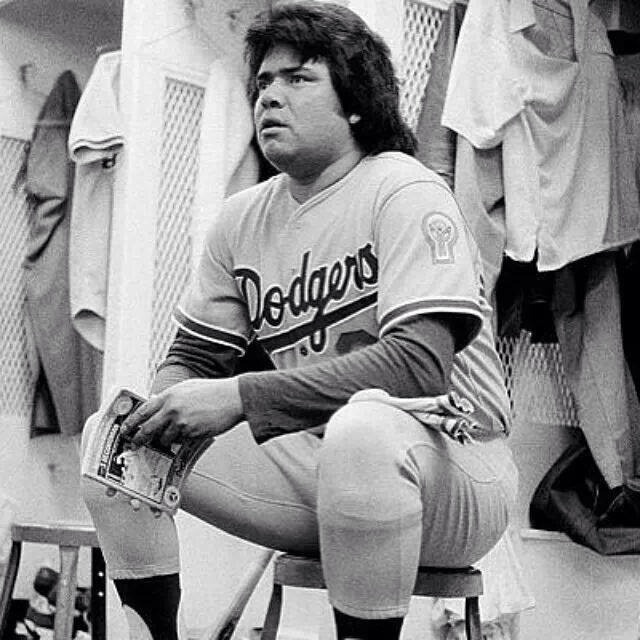
Fernandomania!

There was a time when baseball was the most important thing in my life. I was hooked at an early age, as I began playing when I was seven, and I didn’t stop playing competitively until I was twenty-two, when I was cut from the Rio Hondo Community College team. The first Little League team I played on was the Pittsburgh Pirates. We played our games at Garvey Park in Rosemead, fifteen-minutes from Dodgers Stadium.

Because I was on the Pirates, they became one of my favorite professional baseball teams. I admired Pittsburgh’s winning ways, especially during their “We are Family” era of the 70’s. I was a baseball fan, though, and so I liked a lot of other teams, too.

When I was asked by my coach what position I played, I said, “Catcher.” It is, without a doubt, the greatest position in baseball.  I became a catcher because Thurmon Munson was a catcher. He played behind the plate for the Yankees in the early 70’s. He died in a plane crash six days before my ninth birthday. This may be the reason why I am deftly afraid of plane travel.

When it came to baseball, I always felt as if I was born too late. I missed out on seeing Mantle and Ruth and DiMaggio and Koufax and Robinson. Their time was up. But my era, the 70’s and 80’s, could also boast some of the greatest names in baseball. We had Rose, Carew, Jackson, Henderson, Ozzie, and Stargell. I studied and emulated these players with deep, emotional, out-of-body conviction,  copying the way they walked and spit and banged their bats against their cleats.

Pete Rose was the biggest thief in baseball, and because of Pete, I, too, stole bases. My leads at first base were huge, almost illegal. Pitchers and catchers had no chance in getting me out. My grandma, Maria Del Carmen, made herself sick every time she watched me play. She would tearfully urge me to get back to first and plead with me to shorten my lead. These were the only instances where I didn’t obey my grandma. Covering her eyes, she would yell, “Get back, mijo. Get back! Marcos, get back!” She was my biggest supporter, and I’m sure I gave her nightmares that involved my being picked-off at first or tagged out at second. I never was, though.

Rod Carew made me wish I could switch-hit. Everything he did reeked of sophistication, down to the manner in which he chewed. His left-cheek was perpetually impregnated with a massive wad of tobacco and Wrigley’s Gum. I used to stuff my mouth with unhealthy portions of Big League Chew just to look and feel like Carew. I even became a switch-hitter.

These guys and many other players contributed to the wonder of my childhood, and emulating them was my main hobby. And Every kid I knew imitated one player or another—sometimes even an entire team’s line-up. We all had our favorites, but we made sure to reserve a special place for the one player we each admires above all others.  For me, this one player was Fernando Valenzuela.

I was ten year’s old when Fernando debuted for the Dodgers. It was September 15, 1980, to be exact. The Dodgers were playing the Braves in Atlanta, and Fernando came on in relief. I was watching the game with my granda. We moved into her house in Rosemead where we stayed for a few years while my parents saved to buy a house of their own.

Vin Scully, in his unmistakable inflection and tone, said, “And now, coming on in relief for the Dodgers is nineteen-year-old Fernando Valenzuela, from Sonora, Mexico.” I had to squint at the T.V., even though I had perfect vision. I turned to my grandmother and said, “Grandma, is he Mexican?” “Yes, Mijo, he’s Mexican!” All of sudden, this was not another baseball game. Grandma and I scooted towards the front of the couch and leaned in towards the television to get a clearer look at this chubby, pimply kid who was about to take the mound for the Dodgers.

He was Mexican, but he was like no Mexican I had ever seen, and I had already seen hundreds, including my my 123 cousins. He could’ve easily been a primo or a tio or a tio’s friend, but there was something markedly different about this Mexicano.  He seemed to float on a mist that carried him peacefully to where he needed to be. In Atlanta, on this night, Fernando drifted towards the mound from the bullpen.

Atop the mound, Manager Tommy Lasorda shoved the ball into his glove, gave him a pat on the back, and left him alone. Fernando promptly dug his place in front of the pitcher’s plate, positioned himself, and proceeded to warm-up. I watched every pitch like a lion watches prey. He was a southpaw with a roundhouse, Vida Blue kick that complimented the big, swinging arch of his left-arm as it snapped like a wet towel towards a crouching Steve Yeager.

His windup was akin to the blossoming of a rare flower. It unfolded, beginning with the strategic backwards step of his right leg, in perfect balance and symmetry. Then with a startled change of direction, Fernando kicked the same right leg upward, thrusting it to its highest point before having to bend it at the knee. Simultaneously, his left-foot was  locked into position at the front edge of the pitcher’s plate, the launching point.

While every component in his lower-body pivoted, swung, twisted, and turned, Fernando’s upper-body was conducting its own complex patterns. His hands were in union, his left-hand fiddling with the ball, searching for the sweetest part of the seams. At nineteen-years-old, he already had a “signature pitch.” It was the screwball, a pitch not commonly thrown in the majors, mainly because of the strain and damage it can cause to the elbow, not to mention the difficulty in throwing it. Scully explained the screwball everyone watching and listening. He explained its level of difficulty-how it lacks accuracy and speed. The next day, all the kids in my neighborhood were throwing a screwball.

His windup’s climax too place a split second before he released the ball. As his right leg thrust upward, his knee almost at chin level, his hands in the prayer position covering his face, Fernando’s eyes eerily peeked out just above the top of his glove. When we saw his eyes, we knew. They were the source of his charm. Every pitch emanated from his eyes—his Mexican eyes.

The camera showed a close-up of his face the moment before he let the ball fly. His eyes were completely rolled back into his skull, becoming white dots, scary, like a shark’s eyes before they bite down on prey. There was no vision in them. He wasn’t using them to see! Instead, Fernando used his eyes as a command—a gesture to the heavens to provide his pitches power and accuracy. Finally, just as the pitch was thrown, Fernando turned his face towards the plate, and then we saw, under the bright lights of Chavez Ravine, his young, brown eyes in full focus. Los Angeles had a new hero.

My grandma and I were in awe. We were consumed and taken captive by Fernando and his youth and his indifference. We were watching history.  In our two-dimensional world, we had something very tangible. It was eventually given a name: Fernandomania. My grandma and I saw its birth.

From that point on, my grandma and I saw every game he pitched in that season. There were twenty-one games left after Fernando made his debut. He pitched in ten of them. The next year, in 1981, Fernando won the Cy Young Award, the Rookie-of-the-Year Award, the Silver Slugger Award, and the World Series! Los Angeles was in a cataleptic state of Fernandomania!

Every generation says, “Those were the good ol’ days.” Well, those were the good ol’ days. I miss everything about them, especially my grandma. Baseball? Well, it’s no longer a game. Nowadays, players are given curtain calls for long foul balls. It wasn’t always like this. A player had to do something special, something magical, something Reggie Jackson-like. It’s even rare to see guy chewing a massive glob of something. Instead, most ball players have personalized cleats and gloves. Yeah, the game has changed.

I know kids these days have heroes. They need them, just as I did when I was a kid. For the sake of the game, though, today’s ball players need to just shut up and play ball.

IMG_5450.JPG

Does My Daughter Know I Exist?

This morning, as usual, I’m up before my two daughters and one wife. It was the same yesterday morning, too. I was in the bathroom. I heard the ladies emerge from their quarters with the sounds of turning door knobs then the creaks of wooden floors and then heel-to-toe steps to the living room where my little hens converged to begin their respective days.

I could hear all their chatter as I sat on the shitter a few feet down the hall. I listened with fatherly pride, too, and amusement, as my wife orchestrated the early morning goings on. “Mom, could I have screen time,” asked Xaria. She is six-years-old, and she is into watching these two little English broads who appear regularly on the Ellen Show. They sing and dance and incessantly rant about their likes and dislikes, and they’re always dressed like princesses. Xaria is pretty much rendered incapacitated under their spell. “Yes, you may, Xaria.” Then I heard my wife turn her attention to Iris. Iris was screeching at the top of her lungs, not in anguish, but in pure joy of being in the same room with her mom and sister, I guess. I mean what else could she be giddy about? Guen mimicked her baby sounds and the two jumped into an early morning game of copy-cat, a Cisneros pastime of sorts. 

And I’m in the John. I was pretty much done, but I was content to sit and listen to the morning cacophony of the three girls I live with. Then I got lost in thought. 

Iris was the loudest in the room. She is ten-months-old, and on this morning, she has yet to see me. I knew that Xaria and Guen would greet me with a “Good morning, Daddy,” as soon as I walked into the room. This simple greeting is one of the precious, tiny gifts that comes with fatherhood.

I was thinking about Iris, though. As she scuttled around the room in her walker making do-do, dada sounds and bumping into every piece of furniture we own, I was wondering if she maybe thought about where i was? Does she know I exist? Does she have the tools at her age to think or wonder about me? Or will it be a “Hey, I remember this guy,” moment when she finally sees me?

If this last scenario is the case, then it happens everyday with Iris. And if this is the case, she doesn’t miss me when I go away and return hours later. Actually, this may be the only scenario. I know she can’t blurt out, “Where’s Dad?” I don’t believe she wonders about me, so in a way, it’s a surprise party for her every time I walk in to the room! 

She’s lucky, I guess! Wouldn’t it be nice if our relationships were like this in adulthood. I could wake up next to my wife every morning, roll over and after eye contact yell out, “Hey, what’s up? How are you? It’s good to see you? Where’ve you been?” and just convulse in excitement. Or at work you could run up to your colleagues and administrators on a Tuesday and give them huge hugs and scream, “Whoa! How you guys doing? I remember you! Where were you? It’s been a while!”

Come to think of it, I’m writing this in the early morning. Iris has yet to see me this morning. I have a feeling that a surprise party is about to go down!

Golden Oldies: Germany vs. Argentina

The German National Football Team is supposed to defeat Argentina in Sunday’s 2014 World Cup Final, handily. It’s all but scripture. The Germans have been thoroughly praised for the quality of their performances, especially after their inhumane thrashing of Brazil. The 7-1, victory over the host country did much to convince pundits across the globe that the Deutsch will hoist this year’s World Cup trophy. Some may even dare to say that the game is a mere formality for Germany. They could be right.

After all, in terms of individual talent, the Germans are at the top looking down. They are at the apex of their “Golden Generation,” a football generation just short of being genetically modified to end Germany’s trophy-less drought. They are a group of ridiculously talented young men that have come-of-age together, nurtured and looked after by a country desperate for football success. Now, all of Germany looks to reap the benefits of their collective investment, and a trophy is all they demand. It has been a while.

Being referred to as the Golden Generation isn’t always a term of endearment. Just ask Portugal. After winning consecutive World Youth Championships in 1989 and 1991, success for this group seemed limitless. The team was laden with talent, fielding many of the best players of the 90’s, including Luis Figo, Rui Costa, and Jorge Costa, names to be reckoned with in the European soccer world. But in 2004, after reaching the final of the European Cup, Portugal was humiliated by the darkest of horses in Greece. Portugal has not been in any kind of final since.

England is another fable of sorts. The English assembled a football boy band comprised of English Premiere League players doing very well for their respective clubs at the time. David Beckham was the face of the team, followed by Ashley Cole, Steven Gerrard, Frank Lampard, and a kid named Wayne Rooney. They, too, possessed an abundance of talent. However, club success for these players did not translate into national team success. In fact, England did not qualify for the last European Cup, a blasphemous gesture and end to a highly regarded English football era that produced very little for which to be proud.

The Ivory Coast and the Netherlands are still two more examples of talented teams falling short of expectations. Les Éléphants featured Didier Drogba, Emmanuel Eboue and the Toure brothers. There was even talk that an African nation would finally find success at the highest level. However, after failing to dominate the Africa Cup of Nations, and being knocked out of the group stages at Germany 2006 and South Africa 2010, the Ivory Coast’s hourglass was left to its last grains of sand, falling to the curse of the Golden Generation.

The Netherlands has the dubious distinction of experiencing multiple Golden Generations. In the 80’s, as apt students of the Ajax School of Football, Clarence Seedorf, Edgar Davids, Dennis Bergkamp, Patrick Kluivert, and the De Boer’s, were hailed as Dutch football’s saviors. In the end, their success was barely modest. A fourth place finish in France 1998, was the best this group could do. Eventually, most of these players stepped aside to make room for Holland’s new wave of talent.

A few days ago, in the semi-finals of the 2014 World Cup, the Dutch fielded the remnants of another relatively young and highly talented team, a team led by legendary Dutchman Louis van Gaal, a disciple himself of the Ajax School. Van Gaal and his group reached this point in the competition with seemingly more luck than talent. Nevertheless, Holland were a few penalty misses away from nearly reaching consecutive World Cup Finals, the last in 2010. Wesley Sneijder, Arjen Robben, Robin van Persie, Ron Vlaar, and Klaas jan Huntelaar, highly successful club players, fought for 120 valiant minutes, but the Oranje finally bowed out of the cup, falling to Argentina.

Now, all this isn’t to say that Germany will suffer the fates of past Golden Generations. For their part, the Deutsch have already enjoyed a great deal of football success, last winning the World Cup in Italy 1990, and the they reached the semi-finals when they hosted the tournament in 2006, and again in South Africa 2010. No, this is just to say that the German team playing in this Sunday’s Final fits the full description of a Golden Generation, and expectations are at a maximum.

Bundestrainer Joachim Löw is armed with players who have been battle-hardened at the highest levels of club and international play. Philipp Lahm, Mesut Ozil, Sami Khedira, Thomas Muller, Mats Hummels, Mario Götze, Bastian Schweinsteiger, Lukas Podolski, Toni Kroos, Jérôme Boateng, and Miroslav Klose—the names alone are enough to cause panic. They will rely on goalkeeper Manuel Neuer as their last line of defense. Neuer is arguably the best keeper in all of football, and he’s been spectacular in this year’s competition. It’s either now or never for Löw, as his pot of gold runneth over.

Meanwhile, Argentina will field, on average, the oldest team in the competition. Call them the Onyx Generation or the Silver Generation or even the Blue Topaz Generation. Call them what you will. What you can’t call them is lucky or inexperienced.

The proud La Albiceleste bulled their way into the final backed by three stellar defensive performances. It has been more than 300 minutes since the Argentine defense has allowed a goal in this 2014 World Cup competition. Nigeria put two past them in the group stage, which now seems quite distant.

It’s been a while since Argentina has tasted from the Cup. In 1978, the last time the World Cup was held in South America, in Argentina to be exact, La Albiceleste was triumphant. Eight years later, in 1986, Argentina again lifted the trophy, this time in Mexico. However, in the years that have followed, the furthest Argentina has ventured in the competition are the quarterfinals, three times.

Like Germany, it may be now or never for Argentina. Their key players, Pablo Zabaleta, Javier Mascherano, Maxi Rodriguez, Gonzalo Higuain, and Ezekiel Lavezzi, are getting slightly long in the tooth. They still have Kun Aguero and a young Enzo Perez, who, by the way, was superb in place of injured Angel Di Maria.

Of course, no discussion can be considered legitimate unless Lionel Messi’s name is mentioned. You’d have to be brain dead to not know of him. He is considered the greatest player on Earth, drawing tireless comparisons to Diego Maradona for his speed, agility, size, and overall fooball brilliance. The only other Argentinian perhaps more beloved than Messi is Papa Francisco, or Pope Francis, and even this is debatable. As the German nation urges their team to victory on Sunday, so too will Argentina, with Messi carrying much of the responsibility. If there is any player that can withstand this burden, it is he.

Sunday’s Final is as intriguing as a football match can get. The precise, mechanical, and near perfect German side will not deviate from a formula that has proven successful. Argentina, on the other hand, will rely on their physical play, their experience, and their Messi. I side with experience.

In most of life’s ventures, experience is priceless. Argentina has the experience. They have the talent. They have the will. They have home field advantage. In the end, Argentina will prove just a bit too much for Germany. Look for Messi to have the greatest game of his illustrious career, as La Albicelest once again, call South America their continent.

For the Germans, all that glitters will not be gold.